
C4 News
Cook County Jail Exposed: Nurses and Officers Reveal Toxic Air, Rats, Outbreaks, and Systemwide Neglect
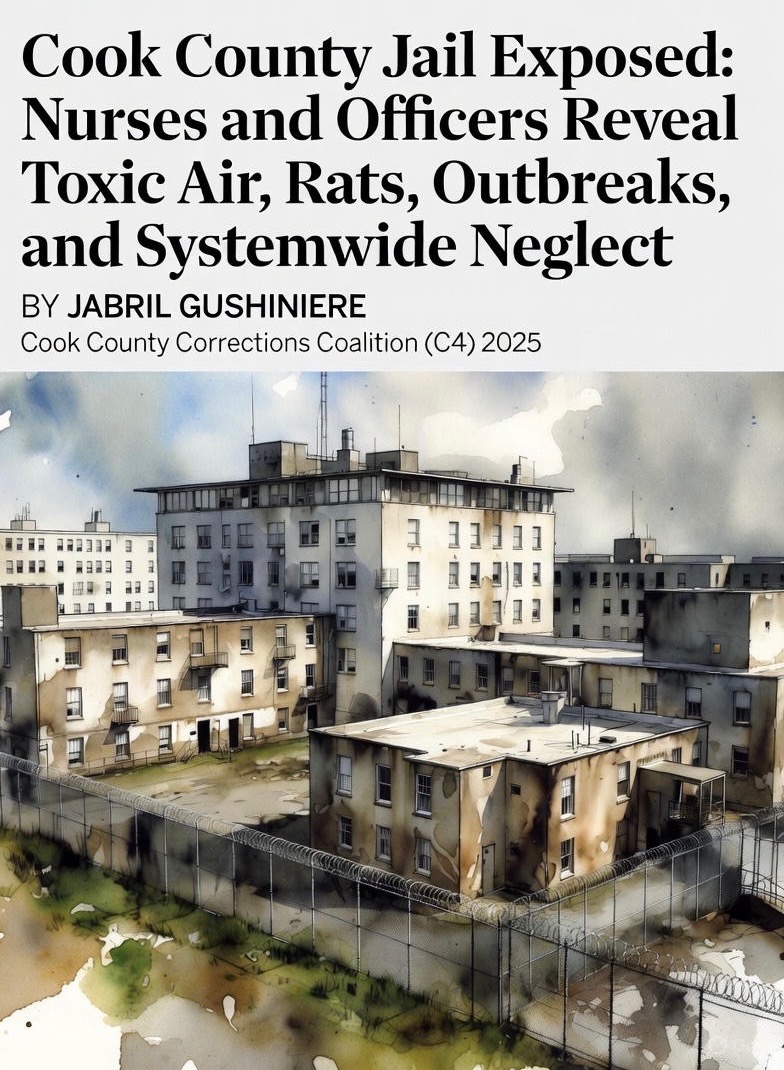
A COUNTY FACILITY IN SYSTEMIC DECAY
Cook County Jail is the largest single-site county jail in America - a place repeatedly marketed as “modernized” and “reformed.” Yet, everyone who works inside knows the truth: the jail operates under conditions that are unsafe, unsanitary, medically dangerous, and inconsistent with federal law, state law, OSHA safety standards, and basic human decency.
Behind these walls, both officers and detainees breathe contaminated air, walk through filth, and face constant exposure to vermin and disease. Sanitation is inconsistent. Disease control is unreliable. Ventilation is failing. Tier equipment is decades out of date. Staff protective gear is practically nonexistent.
This investigation represents:
• firsthand testimony from multiple officers,
• medical statements from multiple licensed nurses,
• documented legal requirements and violations,
• historical patterns identified by the Department of Justice,
• and findings validated by a 2023 Loyola University Law Review analysis titled “If You Die, That’s On You.”
This is not a report on one tier, one incident, or one bad moment.
This is a system-wide environmental collapse - and a County that chooses not to fix it.
THE AIR QUALITY CRISIS - A DAILY ASSAULT ON BREATHING
Officers describe walking into certain divisions and immediately feeling congestion, headaches, burning throats, and difficulty breathing. Nurses report “daily respiratory complaints” from detainees and staff.
Multiple nurses confirmed:
“People need inhalers far more often than prescribed. The mold, temperature swings, and poor ventilation make the symptoms worse.”
Mold is visible in:
• ceilings
• vents
• fans
• walls
• shower areas
Dust blasts from vents when the systems activate. Divisions 6, 9, 10, and 11 have a heavy, stale odor that officers say “hits immediately in the chest.” Detainees regularly ask officers:
“Do you feel this mold too?”
Legal Standards
OSHA - 29 U.S.C. § 654(a)(1) requires workplaces free from recognized hazards.
Illinois Jail Standard § 701.400 requires ventilation that ensures “a healthful atmosphere.”
CCDOC facilities fail both.
PEST INFESTATIONS - RATS, ROACHES, LICE, AND UNIDENTIFIED INSECTS
Every officer interviewed reported daily vermin activity.
Officers describe:
• 16 roaches in the Division 10 locker room in one morning
• mice running across Division 11 pathways between 7–8 AM
• roaches and mice in food carts
• detainees blocking their doors to prevent rats and insects from entering their cells
• dead vermin brought to officers after being found on trays
Multiple nurses confirmed:
“Lice outbreaks occur across entire tiers. We see unidentified insects constantly.”
Legal Standards
OSHA Vermin Standard § 1910.141(a)(5) requires workplaces to prevent rodent/insect harborage.
Illinois Jail Standard § 701.180 mandates active extermination programs.
Antonelli v. Sheahan (7th Cir. 1996) held vermin-ridden conditions unconstitutional.
2025 mirrors 1996.
FILTH, MOLD, DECAY - WHEN A JAIL STOPS BEING CLEANABLE
Officer spaces and detainee spaces share the same rot.
Officer Bathrooms & Locker Rooms
• brown toilet seats
• rusted lockers
• foul odors
• mold in corners and ceilings
• standing water
• broken sinks
• leaks that never get repaired
• missing radio components and chronic lack of functioning radios
Detainee Showers & Common Areas
• filthy floors
• mold and mildew covering walls
• sludge in drains
• showers so dirty officers refuse to enter
• detainees forced to clean with vinegar because inmates - not sanitation professionals - do all cleaning
Multiple nurses stated:
“Sanitation issues clearly cause preventable infections - fungal, bacterial, skin-related. We see it daily.”
Legal Standards
Illinois Jail Standard § 701.160 requires clean, odor-free, well-maintained facilities.
Johnson v. Pelker (1989) confirmed unsanitary conditions + lack of cleaning supplies = unconstitutional.
Vinegar “cleaning” is not legally or medically acceptable.
DISEASE EXPOSURE - AND A CULTURE OF NON-NOTIFICATION
The most alarming pattern described by nurses:
“Officers are not consistently notified when a tier has infectious disease cases.”
This includes:
• COVID
• monkeypox
• flu
• lice
• bed bugs
• fungal infections
• unknown rashes
• unknown insects
Officers enter contaminated tiers without warnings, violating every modern standard of infection control.
OSHA Standards
HAZCOM § 1910.1200 requires hazard notification.
Bloodborne Pathogens § 1910.1030 requires PPE and exposure training.
Multiple nurses confirmed:
“CCDOC has provided no PPE since COVID.”
Officers report they are not provided with gloves, N95 masks, face shields, hazmat suits, or protective debriefings - despite constant exposure to biological hazards.
EQUIPMENT FAILURE - OBSOLETE, DANGEROUS, AND NON-FUNCTIONAL
Officers report:
• radios that die daily
• radios missing parts
• not enough radios for assigned staff
• emergency buttons that do not activate
• failing tier doors
• malfunctioning locks
• outdated control panels
• insufficient protective equipment
OSHA’s General Duty Clause requires employers to eliminate recognized hazards.
These failures put lives at risk.
The DOJ’s 2008 CRIPA findings cited emergency system failures.
Seventeen years later, little has improved.
WATER QUALITY, DIGESTIVE ILLNESS, AND MEDICAL PATTERNS
Multiple nurses consistently receive complaints from Division 5 detainees regarding:
• foul-smelling water
• digestive issues
• skin irritation
The 2023 Loyola Law Review article documented similar concerns, including moldy food, lack of clean water, and medical negligence.
Legal Framework
Board v. Farnham (2005) confirmed unsafe water violates constitutional rights.
Illinois sanitation standards require potable water.
CCDOC continues to ignore documented hazards.
MEDICAL EMERGENCIES - UNKNOWN DRUGS, UNKNOWN RISKS
Nurses reported:
“Staff and detainees have had medical emergencies - including 911 calls - from inhaling unknown substances inmates smoked.”
Officers receive no training, PPE, or debriefing protocols for chemical exposure.
This puts staff and detainees at severe medical risk.
DIVISION 8 / CERMAK - MEDICAL & MENTAL HEALTH NEGLECT IN THE BASEMENT
Division 8 (Cermak) houses detainees with medical and mental-health needs. Yet, multiple officers and nurses report a disturbing practice:
Detainees in crisis are placed in basement holding cells for hours or days, without bathrooms, often forced to urinate or defecate on the floor.
These cells:
• have no toilets
• have no sanitation
• are not designed for extended holding
• are frequently overcrowded
• are not cleaned between occupants
• subject vulnerable people to trauma and health risks
This is consistent with findings in the Loyola Law Review article, which documented:
• inadequate medical care
• punishment replacing treatment
• grievance failures
• violations of disability rights
Cermak’s basement holding pattern is one of the jail’s most critical - and least discussed - humanitarian failures.
OVERSIGHT FAILURE - WHEN EVERY WATCHDOG CLOSES ITS EYES
This crisis persists because:
• OSHA does not conduct meaningful inspections
• IDOC inspections note issues but enforce nothing
• CCDOC leadership conceals hazards before director visits
• maintenance requests are ignored
• Facilities Management uses temporary fixes
• Internal Compliance functions as a formality
• inmates clean the jail instead of professional sanitation staff
• the union remains silent
• County leadership refuses to acknowledge systemwide environmental collapse
Multiple nurses reported:
“Leaking ceilings are reported repeatedly but never fixed.”
Every oversight body is aware.
None act.
TWO POPULATIONS, ONE HAZARDOUS ENVIRONMENT
Officers and detainees breathe the same contaminated air, walk through the same filth, step around the same vermin, and face the same diseases.
This is not just a jail problem.
This is a public-health crisis and a workplace-safety emergency.
C4 REFORM DEMANDS
C4 demands:
1. Immediate and bi-weekly OSHA inspections
2. Independent environmental audits
3. Modernized ventilation systems
4. Mandatory infectious-disease notification protocols
5. Tier-by-tier pest eradication programs
6. Replacement of radios, locks, lights, doors, and safety equipment
7. Sanitation overhaul using proper chemicals and professional cleaning crews weekly
8. Water-quality testing and remediation in all divisions
9. Adequate PPE for officers and detainees (gloves, N95s, face shields, hazmat suits)
10. Renovation of locker rooms, restrooms, showers, and mold-damaged infrastructure
11. Public transparency on all maintenance and sanitation logs
These demands are not radical - they simply require the County to follow OSHA, CDC, and Illinois Jail Standards.
CONCLUSION - A JAIL HIDING A HUMANITARIAN AND OCCUPATIONAL EMERGENCY
Cook County Jail is not merely outdated.
It is unsafe, unsanitary, medically dangerous, and non-compliant with federal and state requirements.
Multiple nurses summarized the environment plainly:
“Dirty and unsafe… high risk of disease transmission.”
C4 will continue documenting, exposing, and demanding accountability until every leader responsible for this crisis is forced to address it.
This is only the beginning.
UPDATED SOURCES & REFERENCES
LAW REVIEW & ACADEMIC SOURCES
Loyola University Chicago School of Law - Public Interest Law Reporter
Nichols, Leanna (2023). “If You Die, That’s On You: The Persistence of Inhumane Conditions at Cook County Jail.”
https://lawecommons.luc.edu/cgi/viewcontent.cgi?article=1663&context=pilr
FEDERAL LAW & OSHA REGULATIONS
OSHA General Duty Clause - 29 U.S.C. §654(a)(1)
https://www.osha.gov/laws-regs/oshact/section5-duties
OSHA Sanitation Standard — 29 CFR §1910.141
https://www.osha.gov/laws-regs/regulations/standardnumber/1910/1910.141
OSHA Vermin Standard — 29 CFR §1910.141(a)(5)
https://www.osha.gov/laws-regs/regulations/standardnumber/1910/1910.141
OSHA Hazard Communication (HAZCOM) — 29 CFR §1910.1200
https://www.osha.gov/hazcom
OSHA Bloodborne Pathogens — 29 CFR §1910.1030
https://www.osha.gov/laws-regs/regulations/standardnumber/1910/1910.1030
ILLINOIS JAIL & DETENTION STANDARDS (TITLE 20)
Illinois Administrative Code — Title 20, Part 701 (full index)
https://ilga.gov/commission/jcar/admincode/020/02000701sections.html
§701.160 – Sanitation
https://ilga.gov/commission/jcar/admincode/020/020007010000160R.html
§701.180 – Vermin Control
https://ilga.gov/commission/jcar/admincode/020/02000701000180R.html
§701.260 – Cleaning Supplies
https://ilga.gov/commission/jcar/admincode/020/02000701000260R.html
§701.400 – Ventilation
https://ilga.gov/commission/jcar/admincode/020/02000701000400R.html
CDC GUIDANCE
COVID-19 Correctional Facility Guidance
https://www.cdc.gov/coronavirus/2019-ncov/community/correction-detention/guidance-correctional-detention.html
CDC Ventilation Guidance
https://www.cdc.gov/coronavirus/2019-ncov/community/ventilation.html
CDC Lice Prevention
https://www.cdc.gov/parasites/lice/head/prevent.html
CDC Environmental Infection Control
https://www.cdc.gov/infectioncontrol/guidelines/environmental/index.html
NIOSH Correctional Health & Safety
https://www.cdc.gov/niosh/topics/correctionalhs/default.html
DEPARTMENT OF JUSTICE (DOJ)
CRIPA Findings Letter — Cook County Jail (2008)
https://www.justice.gov/sites/default/files/crt/legacy/2011/04/13/CookCountyJail_findingsletter_7-11-08.pd
DOJ Summary Release
https://www.justice.gov/archive/usao/iln/chicago/2008/pr0717_01a.pdf
STATE AGENCY DOCUMENTS
IDOC - 2024 Cook County Jail Inspection Report
https://idoc.illinois.gov/content/dam/soi/en/web/idoc/aboutus/jds2017/2024-jail-inspections/Cook%20County.pdf
MEDIA INVESTIGATIONS
NPR - “Cook County Settles Hundreds of Lawsuits…”
https://www.northernpublicradio.org/news/2017-05-12/cook-county-settles-hundreds-of-lawsuits-over-jail-conditions
Injustice Watch - “The Big Chill”
https://www.injusticewatch.org/criminal-courts/cook-county-jail/2016/the-big-chill-inmates-contend-county-cheating-on-ensuring-warm-jail-cells/
Unicorn Riot — Correctional Whistleblowing
https://unicornriot.ninja
FEDERAL & SEVENTH CIRCUIT CASE LAW
Antonelli v. Sheahan, 81 F.3d 1422 (7th Cir. 1996)
https://law.justia.com/cases/federal/appellate-courts/F3/81/1422/563925/
Board v. Farnham, 394 F.3d 469 (7th Cir. 2005)
https://law.justia.com/cases/federal/appellate-courts/F3/394/469/521387/
Johnson v. Pelker, 891 F.2d 136 (7th Cir. 1989)
https://law.justia.com/cases/federal/appellate-courts/F2/891/136/350183/
Hardeman v. Curran, 933 F.3d 816 (7th Cir. 2019)
https://law.justia.com/cases/federal/appellate-courts/F3/933/816/
Camacho v. Dart, No. 15-cv-3396 (N.D. Ill. 2017)
https://law.justia.com/cases/federal/district-courts/illinois/ilndce/1:2015cv03396/309591/
Kingsley v. Hendrickson, 576 U.S. 389 (2015)
https://supreme.justia.com/cases/federal/us/576/389/
Farmer v. Brennan, 511 U.S. 825 (1994)
https://supreme.justia.com/cases/federal/us/511/825/
PUBLIC HEALTH DATA
Bureau of Justice Statistics — Correctional Facility Health
https://bjs.ojp.gov
FIRSTHAND, VERIFIED INTERNAL TESTIMONY — CONFIDENTIAL
Multiple Licensed Nurses (2025)
• air quality complaints
• mold exposure symptoms
• lice outbreaks
• sanitation failures
• PPE shortages
• Division 5 water-quality issues
• Cermak basement holding-cell practices
Multiple Correctional Officers (2025)
• daily vermin sightings
• mold in vents & ceilings
• roaches/mice in food carts
• broken radios, missing radio parts, insufficient radios
• unsafe equipment
• basement holding-cell eyewitness accounts
(Full names withheld for safety; documentation on file with C4.)
© 2025 Cook County Corrections Coalition (C4).
Authored by Jabril Gushiniere. All Rights Reserved.
No part of this publication may be reproduced, distributed, or transmitted in any form or by any means, including photocopying, recording, or other electronic or mechanical methods, without the prior written permission of C4. Unauthorized use, duplication, or distribution is strictly prohibited.








JOIN THE COALTION
You Wear the Badge. Now Join the Movement.
You deserve to be protected at work, to be compensated for your service, and respected for your actions. We will advocate for you. Whether you are a part of C4 or not, you deserve to have the protections we are fighting for, for yourself, for your family, and for your future. We must stand united. We will fight for you and the time to fight is now.
Join C4
Join the movement. Join the fight. Stand united.
We will provide you with a welcome email, informationals, invitations to meetings, and any advocacy support you may need.
Get Informed
Sign up to receive information, statistics, and updates.