
C4 News
The Contract That Betrayed Us
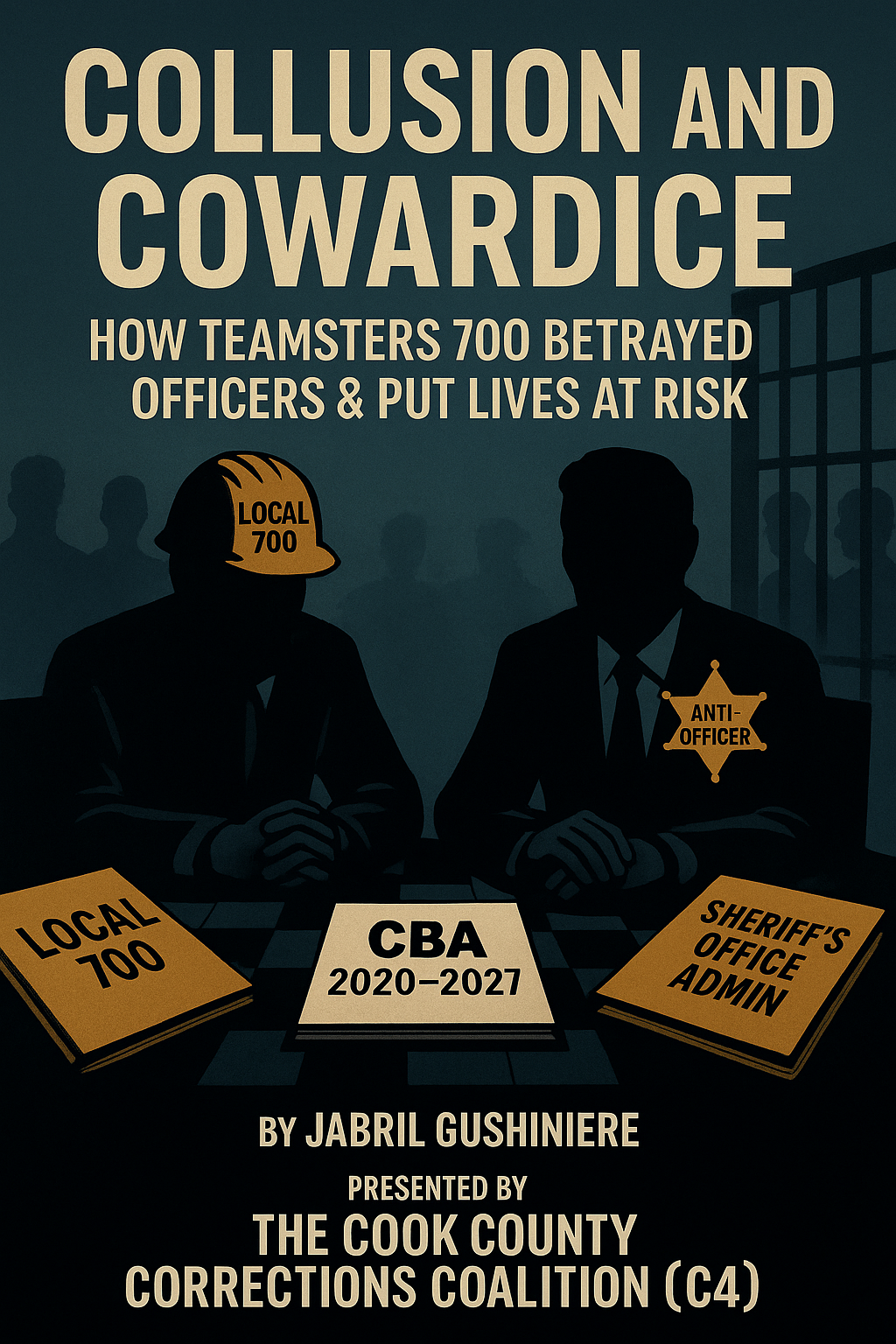
I. INTRODUCTION - A CONTRACT WRITTEN AGAINST ITS OWN MEMBERS
Across the United States, union contracts are built on a single principle:
protect the workers.
Protect their bodies.
Protect their rights.
Protect their families.
Protect their future.
But inside Cook County Jail, the largest single-site jail in America, the 2020–2024 (Extended To 2027) Teamsters Local 700 CBA stands as something else entirely:
• a contract that protects management,
• shields administration,
• guarantees union dues,
• and leaves officers exposed to the most dangerous working conditions in the country.
Officers hold the idea of the contract today believing it contains protections.
But once you look closely - once you actually read the language word for word - a disturbing reality emerges.
The protections are illusions.
The language is hollow.
And every meaningful safeguard is undermined by vague clauses, broad employer discretion, or deliberate omission.
This is not incompetence.
This is engineering.
The CBA is a document written to appear protective, while structurally empowering Cook County to:
• understaff units,
• force cross-watching,
• mandate exhausted officers,
• cut pay when officers are injured,
• deny ADA accommodations,
• retaliate without consequence,
• and strip officers of legal leverage.
Worse:
The Teamsters 700 negotiated this contract AFTER binding Illinois case law gave officers the right to refuse unsafe assignments - and the union still refused to include a single line protecting officers from cross-watching.
This exposé will show:
• The exact CBA language that harms you
• The contradictions inside the contract
• The omissions that expose the union’s alignment with the employer
• The timeline proving the union ignored controlling case law
• The consequences officers face every day because of these failures
• And finally: what a real contract, a C4 contract, would look like if officers had true representation
Because if the Teamsters will not fight for you, then officers must begin imagining what representation should look like.
We begin with the most life-threatening omission in the entire document.
II. CROSS-WATCHING — THE DANGER THE UNION CHOSE NOT TO STOP
No issue has caused more injuries, more lawsuits, more inmate deaths, and more discipline against officers than cross-watching.
Cross-watching is not a minor inconvenience.
It is a structural hazard.
When one officer is forced to supervise:
• multiple tiers,
• multiple dayrooms,
• multiple decks,
• dozens of inmates across separate lines of sight
• or high-risk mental health or segregation populations
You are placed in a situation where:
• you cannot respond fast enough,
• you cannot see everything,
• you cannot control movement,
• and you will be blamed when something goes wrong, even when it was impossible to prevent.
Despite this, the CBA contains no sentence, no clause, no definition, and no prohibition addressing cross-watching.
Not one.
Instead, the CBA empowers cross-watching through vague employer-centric language - and officers need to see it for themselves.
We now quote the contract verbatim.
III. VERBATIM CBA LANGUAGE - HOW THE CONTRACT ENABLES CROSS-WATCHING
Article II -Management Rights
“Section 2.1 - Management Rights: The Employer retains the exclusive right to determine its mission, including the right to manage the operations, the number of employees, and to determine the methods, means and personnel required.”
This sentence alone gives Cook County the ability to:
• assign one officer to two tiers,
• assign one officer to a violent dayroom alone,
• force officers into out-of-class assignments,
• redefine officer duties at will,
• AND claim it is within their contractual rights.
The union agreed to language so broad that it overrides any supposed “safety protections” elsewhere in this contract.
Because nowhere in the contract does it say:
• an officer cannot watch two living units
• an officer cannot supervise multiple tiers alone
• an officer must have a partner
• a dayroom cannot be opened without adequate backup
• a mental health tier requires two officers
• a segregation tier requires multiple officers
• a hospital escort team cannot be solo
The omission is not accidental.
It is structural.
The union left your most dangerous assignment completely unregulated.
But the worst part?
The union did this despite having controlling case law that protected officers from cross-watching.
Let’s look at that case - and the exact ruling date.
IV. JANDA & BOLLINGER V. COOK COUNTY — THE CASE LAW THE UNION IGNORED
Date of ruling:
April 19, 2018 (Illinois Labor Relations Board decision)
Affirmed by the Illinois Appellate Court on June 10, 2020.
What the case held:
• Officers have the right to refuse unsafe assignments.
• Cross-watching qualifies as an unsafe assignment when it exceeds reasonable job scope.
• Refusal to perform unsafe or out-of-class duties is a protected activity under Illinois labor law.
• The employer cannot discipline or retaliate for such refusal.
This case was decided before the 2020–2024 CBA was signed.
The union knew officers legally had the right to refuse cross-watching.
The union knew the County could not discipline you for refusing unsafe work.
The union knew the courts had ruled in favor of officers.
Yet, when it came time to negotiate the new contract, Teamsters did not:
• include a clause prohibiting cross-watching
• include a clause defining unsafe work
• include a clause protecting refusal of unsafe assignments
• include a clause referencing Janda/Bollinger
• even acknowledge the case law, despite it being posted all over the county.
They acted as if the ruling never happened.
This is not negligence.
This is alignment with the employer’s interests.
V. JANDA & BOLLINGER v. COOK COUNTY - CASE LAW AND ITS IMPLICATIONS
To understand the magnitude of what the union ignored, officers need to see the exact words the Illinois Labor Relations Board used when ruling in the officers’ favor.
Below are key excerpts quoted verbatim from the ILRB’s April 19, 2018, ruling in Janda & Bollinger v. Cook County, and the June 10, 2020, Appellate Court affirmation.
A. VERBATIM ILRB RULING LANGUAGE (April 19, 2018)
(Officers need to read this carefully - this is the protection the union pretended did not exist.)
“An employee engages in protected activity when refusing to perform an assignment that is unsafe, unreasonable, or outside the scope of the employee’s classification.”
“The employer may not retaliate against an employee for refusing work under conditions in which the employee reasonably believes such work would endanger their health or safety.”
“Cross-assignment of duties that materially expand the employee’s responsibilities beyond the recognized scope of work may constitute an unfair labor practice when enforced through discipline.”
“Cook County violated the Act when it attempted to discipline officers who refused duties outside their established classification where such duties posed an unreasonable safety risk.”
B. VERBATIM APPELLATE COURT AFFIRMATION (June 10, 2020)
“The County’s insistence that correctional officers perform duties outside their assigned operational area, without adequate support or staffing, created conditions that justified refusal under protected activity.”
“The Board correctly held that no employee may be compelled to undertake an assignment that materially increases risk to personal safety beyond that contemplated in the negotiated classification.”
“Retaliatory action taken against an employee for refusal of unsafe or out-of-class work constitutes a per se violation of the Illinois Public Labor Relations Act.”
C. WHAT THIS MEANS IN PLAIN LANGUAGE
The courts said:
• Cross-watching can be unsafe
• Cross-watching can be outside classification
• Officers can refuse cross-watching
• Refusal is legally protected
• Retaliation for refusal is illegal
This ruling predates the 2020–2024 CBA.
The union knew this was the law.
The union knew officers had the right to refuse cross-watching.
The union knew the County could not discipline refusal of unsafe work.
And yet:
Not one sentence in the CBA mentions Janda & Bollinger.
Not one sentence codifies the right to refuse unsafe assignments.
Not one sentence bans cross-watching.
This omission is not an oversight.
It is a decision.
A decision that favors the County’s operational flexibility over officer safety.
VI. WHAT THE UNION SHOULD HAVE DONE BUT CHOSE NOT TO DO
A competent union, negotiating after Janda/Bollinger, would have inserted language like:
“No officer shall be assigned to supervise more than one tier, dayroom, or housing unit simultaneously.”
“No officer shall be disciplined for refusing an assignment that is unsafe or out-of-class.”
“Cross-watching, as defined by the practice of supervising multiple secured areas at once, is prohibited.”
Instead?
Teamsters left the County with absolute freedom - and left officers with exposure to violence, liability, and wrongful discipline.
To show how blatant this omission is, we now turn back to the CBA and quote the union’s supposed “safety protections” verbatim.
And when you read them, the reality becomes undeniable:
The contract promises “safety” but contains no mechanisms or standards to guarantee it.
VII. VERBATIM CBA QUOTES - “SAFETY PROTECTIONS” THAT PROVIDE NO PROTECTION
Below is the actual language Teamsters gave you.
Article XII - Safety and Working Conditions
“Section 12.1 — Safe Working Conditions: The Employer shall make reasonable provisions for the safety and health of employees.”
That’s it.
That is the entire “protection.”
One sentence.
No definitions of safety.
No staffing ratios.
No partner requirements.
No cross-watch prohibitions.
No emergency limits.
No enforcement.
No grievance triggers.
No standards whatsoever.
Then comes the employer’s escape hatch:
“Section 12.2 — Operational Needs: Assignments shall be made in accordance with the operational needs of the department.”
This line kills Section 12.1 entirely.
Because the County can always claim:
• “We needed this post covered.”
• “We needed this officer to cross-watch.”
• “We needed to open the dayroom.”
• “We needed to run the tier with one officer.”
And because the union left the language vague and undefined, officers have no contractual basis to fight it.
This is the heart of the problem:
The CBA’s safety promise is cancelled out by the County’s discretion clause.
And the union allowed it this way.
VIII. THE MOST DAMAGING CONTRADICTION IN THE ENTIRE CBA
Let’s compare the safety language directly to Article II.
Safety Clause
“The Employer shall make reasonable provisions for the safety and health of employees.”
Management Rights Clause
“The Employer retains the exclusive right to determine its mission, including the right to manage the operations, the number of employees, and to determine the methods, means and personnel required.”
This creates a fatal contradiction:
• The County must keep you safe, but…
• The County exclusively determines staffing, assignments, methods, and personnel - even if those choices make the job unsafe.
When two contract clauses conflict, the one with specific management authority wins.
Meaning:
The safety clause is functionally worthless.
The management rights clause governs everything.
This is not an accident.
This is a design.
A design that prioritizes the Sheriff’s Office’s operational convenience over officer safety.
X. MANDATORY OVERTIME - HOW THE CBA LEGALLY ENABLES STAFFING ABUSE
Mandatory overtime is one of the most dangerous and psychologically damaging practices in Cook County Jail.
Officers routinely work:
• 16-hour days
• involuntary doubles
• back-to-back mandates
• shifts while exhausted, injured, or medically compromised
Fatigue is a major cause of:
• staff assaults
• inmate violence
• accidents
• disciplinary write-ups
• operational errors
• mental health breakdowns
• driving accidents on the way home
Yet the CBA - the document that should protect you - was deliberately written to give the County absolute authority to mandate officers with virtually no limits.
Below is the language exactly as it appears in your contract, so every officer can see how this system was engineered to fail them.
XI. VERBATIM CBA QUOTE - OVERTIME AND MANDATION
Article III - Hours of Work and Overtime
“Section 3.3 — Overtime: Overtime is defined as all time worked in excess of the normal workday or workweek. Overtime shall be compensated at the rate of one and one-half (1½) times the regular rate of pay.”
This section only defines overtime.
It does not limit mandation.
It does not protect officers from fatigue.
It does not prohibit mandatory doubles.
Now the part that gives the County complete control:
“Overtime shall be assigned in accordance with the operational needs of the Department.”
That single sentence authorizes all abuses:
• unlimited mandation
• refusal to relieve officers
• forcing staff to stay even when medically unsafe
• repeated doubles
• mandating officers into dangerous units
Because “operational needs” is undefined, the County can claim that everything is an operational need.
And the union agreed to this language.
XII. WHAT IS MISSING FROM THE CONTRACT - AND WHY IT MATTERS
A real union contract would include:
• maximum number of mandates per week
• maximum number of mandates per month
• prohibition on back-to-back double shifts
• rest period guarantees
• fatigue protections
• medical exemptions
• maximum shift length
• emergency-only exceptions
• transparency requirements
• staffing ratios
• disciplinary immunity for refusing unsafe overtime
Teamsters CBA includes none of these.
Not one.
This is not normal.
Not for corrections.
Not for law enforcement.
Not for any union with bargaining power.
This omission is intentional - because limiting mandation would force the County to hire and retain more officers, which they do not want to do.
The union should have fought this.
They didn’t.
XIII. HOW THE OVERTIME CLAUSE CONTRADICTS OTHER PARTS OF THE CBA
The contract claims officers will have “safe working conditions” - yet:
• forcing exhausted officers into violent units is not safe
• making an officer work a 16-hour shift and then disciplining them for mistakes is not safe
• mandating officers on light duty is not safe
• mandating officers into divisions where assaults recently occurred is not safe
The contradiction is clear:
Safety Clause: “The Employer shall make reasonable provisions for the safety and health of employees.”
Overtime Clause: “Overtime shall be assigned in accordance with the operational needs of the Department.”
This means:
Safety is conditional.
Overtime is unrestricted.
Operational needs always win.
Again, this is not a drafting error.
This is a design feature to protect management.
XIV. THE RESULT: DISCIPLINE AND TERMINATION OF EXHAUSTED OFFICERS
Mandation leads directly to:
1. Officers falling asleep on duty
→ disciplined or fired
2. Officers making minor mistakes
→ written up, suspended, sent to OPR
3. Officers being held responsible for inmate injuries or deaths
→ job and life threatening consequences
4. Officers refusing mandation due to exhaustion
→ charged with insubordination, potentially fired
And when officers are walked off the compound?
The union sends no attorney.
Only a union representative -
A union rep with no legal training -
and no ability to advocate, negotiate, or legally protect the officer.
Officers being terminated -
the most serious moment of their career -
receive no legal defense, despite millions in dues collected every year.
This is not representation.
This is abandonment.
XVI. INJURED ON DUTY (IOD) - HOW COOK COUNTY OFFICERS BECAME THE ONLY LAW ENFORCEMENT PERSONNEL IN ILLINOIS WITHOUT FULL PROTECTION
Across the State of Illinois, nearly every sworn law enforcement group receives:
• 100% IOD pay,
• full salary continuation,
• full medical coverage,
• no loss of benefit time,
• no financial penalty for being injured while protecting the public.
This standard exists under the Public Employee Disability Act (PEDA)
5 ILCS 345 - a statewide statutory guarantee for law enforcement and police personnel injured in the line of duty.
But there are two outliers:
• Chicago Police Department
• Cook County Correctional Officers
CPD remedied this through their union contract:
They negotiated one full year of 100% IOD pay.
Cook County correctional officers?
You get NONE of that.
Your pay is cut.
Your benefits are drained.
You are forced back to work prematurely.
You are punished for being injured protecting the jail.
And the most damning part:
Your union agreed to this. They did not fight for 100% IOD pay.
They did not demand parity with every other county.
They did not even attempt to restore the protection CPD gained.
Officers need to see exactly what the CBA says - and, more importantly, what it does not say.
XVII. VERBATIM CBA QUOTE - DUTY INJURY LANGUAGE
Article XIV — Duty Injury and Disability Provisions
“Section 14.11 — Duty Injury: Employees injured while acting within the scope of their duties shall receive benefits in accordance with applicable law.”
This is the only duty injury language in the entire contract.
Just one sentence.
Sixteen words.
It provides:
• no salary continuation
• no 100% IOD guarantee
• no benefit preservation
• no medical leave protections
• no light-duty rights
• no return-to-work safeguards
• no restrictions on forced return
• no limits on placing injured officers into punitive assignments
To understand how intentionally hollow this is, read the next part of the same section.
“Nothing herein shall be construed to require the Employer to create light duty assignments.”
This is catastrophic.
Because it means:
• The County can refuse to accommodate your injury.
• The County can send you home without pay.
• The County can force you onto FMLA instead of IOD.
• The County can claim no available light-duty posts and cut your income.
And since the union failed to define accommodation rights,
the County’s interpretation always wins.
XVIII. WHAT IS MISSING - AND WHY THAT MATTERS MORE THAN WHAT IS WRITTEN
A real union contract, in any modern law enforcement agency, includes the following protections:
1. 100% salary for all duty-related injuries
Cook County officers do not have this.
2. Prohibition on forcing injured officers into unsafe assignments
Cook County officers do not have this.
3. Medical decision-making left to treating doctors — not administration or IME
Cook County officers do not have this.
4. Automatic placement into safe and appropriate light-duty positions
Cook County officers do not have this.
5. Protection from retaliation upon returning from IOD
Cook County officers do not have this.
6. Priority in bidding and restoration of pre-injury assignment
Cook County officers do not have this.
7. Explicit ADA compliance language
Cook County officers do not have this.
8. Parity with statewide law enforcement disability standards
Cook County officers do not have this.
These omissions are not accidental.
They reduce County liability - and reduce union responsibility.
XIX. WHY YOU - AND ONLY YOU - PAY THE PRICE
When officers are injured:
• your pay is cut
• your household suffers
• your benefits get drained
• you face pressure to return early
• you risk reinjury
• you lose bidding rights
• you lose overtime
• you are placed wherever the County wants
• you are exposed to retaliation
• you receive no legal support if things go wrong
This is the unspoken reality inside the jail:
The institution treats officers like disposable parts -
and the union provided a contract that allows them to do it.
Nowhere else in Illinois does this happen to sworn personnel.
The fact that Cook County officers remain unprotected is not a coincidence -
it is the result of a union that did not fight.
XXI. GRIEVANCES, TERMINATION, AND THE UNION’S DELIBERATELY WEAK REPRESENTATION STRUCTURE
If the CBA failed you on safety and IOD protections, the grievance process is supposed to be the remedy.
This is the mechanism where officers can challenge:
• unfair discipline
• unsafe assignments
• retaliation
• wrongful write-ups
• contract violations
Yet every officer knows the grievance system in Cook County is a graveyard.
Grievances don’t resolve problems.
They bury them.
To understand why, we must read the contract’s grievance language exactly as written.
XXII. VERBATIM CBA QUOTE — GRIEVANCE PROCEDURES DESIGNED TO FAIL
Article XI - Grievance Procedure
“Section 11.1 – Purpose: The purpose of the grievance procedure is to provide an orderly method for resolving differences arising from the interpretation or application of this Agreement.”
Sounds standard.
But here is the part that matters - and the part the union agreed to.
“Section 11.3 - Step 1: The employee shall present the grievance to the immediate supervisor within ten (10) working days.”
This gives the County the first chance to deny everything - and they always do.
Now Step 2:
“Section 11.4 - Step 2: If the grievance is not settled in Step 1, it shall be reduced to writing and presented to the department head, who shall respond within ten (10) working days.”
Again - the department head is management.
Management denies grievances reflexively.
Now Step 3:
“Section 11.5 - Step 3: If the grievance remains unresolved, it may be referred to Labor Relations, who shall issue a decision.”
Labor Relations works for the Employer.
Not for you.
Not neutral.
Not impartial.
Now the critical part - arbitration.
“Section 11.6 – Arbitration: The Union may refer the grievance to arbitration.”
The Union may
not shall,
not must,
not is required to.
This sentence destroys the entire grievance process.
Because if the union chooses not to arbitrate - which they often do - the officer’s case dies.
And the employer knows it.
XXIII. THE UNION’S MOST STRATEGICALLY DAMAGING DECISION: THEY RARELY BRING LAWYERS
When officers are:
• written up,
• placed under investigation,
• walked off the compound,
• brought to HR for termination meetings,
• confronted with allegations,
• accused of policy violations,
• or facing OPR interviews,
They expect their union to bring legal muscle.
Instead, the Teamsters send:
another union rep with no legal training,
no ability to argue statutory protections,
no understanding of evidentiary rules,
no knowledge of administrative law,
no licensing,
no authority.
This leaves officers defenseless.
Union reps cannot:
• object to questions
• demand disclosure
• challenge improper discipline
• assert ADA rights
• assert IOD rights
• assert ILRA protections
• defend against termination
• prepare a legal case
• negotiate legally binding agreements
• file injunctions
• or cite case law
Yet Teamsters Local 700 collects millions in dues annually.
Where is that money going?
Not toward lawyers.
Not toward arbitration.
Not toward officer defense.
Many officers have reported to C4 that in their most critical moments - at the literal brink of firing - the union provided nothing more than a rep who “stood there and watched.”
That is not representation.
That is symbolic attendance.
And the Employer knows the union won’t fight.
So, discipline becomes easier.
Terminations become routine.
Retaliation becomes safe.
This is how collusion works without ever needing to be spoken aloud.
XXIV. THE CONTRADICTION: A CONTRACT THAT IS HARD TO DEFEND BECAUSE THE UNION DOESN’T DEFEND IT
The CBA has an arbitration clause, but:
• grievances rarely reach arbitration
• the union rarely approves arbitration
• officers are discouraged from escalating
• discipline goes unchecked
• wrongfully accused officers suffer
• and most catastrophic of all: the County never fears consequences
A contract without enforcement is not a contract.
It is a brochure.
XXV. VERBATIM CBA QUOTE - NO-STRIKE CLAUSE: THE UNION’S SURRENDER
Now we move to the most revealing clause of all.
Article XII - No Strike
“Section 12.1 — No Strike: The Union agrees that during the term of this Agreement, neither the Union nor any employee shall engage in or encourage any strike, work stoppage, slowdown, or refusal to perform assigned duties.”
This clause is absolute.
There are:
• no exceptions for unsafe work,
• no exceptions for retaliatory assignments,
• no exceptions for chronic understaffing,
• no exceptions for cross-watching,
• no exceptions for unlawful conditions,
• no exceptions for violations of the CBA or Illinois law.
This clause removes:
• all leverage
• all pressure
• all negotiation power
• all ability to resist management abuse
A union with no ability to strike has no bargaining power.
And Cook County knows it.
This is why:
• they continue to understaff
• they continue to force mandates
• they continue to cross-watch
• they continue to cut IOD pay
• they continue to retaliate
• they continue to stonewall grievances
• they continue to place injured officers wherever they want
• they continue to violate ADA
• they continue without fear
Because there is no consequence.
The union traded away its only weapon - and got nothing in return.
Or did they?
XXVII. SENIORITY & BIDDING - HOW THE CBA ENABLES FAVORITISM, RETALIATION, AND MANIPULATED ASSIGNMENTS
Seniority is supposed to be the great equalizer in law enforcement contracts.
It is the mechanism that prevents:
• retaliation
• favoritism
• political games
• discrimination
• assignment manipulation
But not in Cook County.
In Cook County, seniority is a slogan - not a protection.
The CBA provides a framework for seniority, but then guts it with:
• vague language,
• employer discretion clauses,
• procedural loopholes,
• and zero transparency requirements.
To understand how this system is intentionally weakened, officers must see the seniority language exactly as written.
XXVIII. VERBATIM CBA QUOTE - SENIORITY PROVISIONS
Article IV - Seniority
“Section 4.1 – Definition: Seniority shall be defined as the length of continuous service with the Employer in the bargaining unit.”
This looks normal at first.
But now watch how the contract immediately undermines that definition.
“Section 4.2 - Application
Seniority shall apply in the areas of layoffs, recalls, and bid assignments where applicable, provided the employee is qualified to perform the work.”
Two dangerous phrases appear here:
1. “where applicable”
2. “provided the employee is qualified”
Both are escape hatches for management.
A. “Where applicable”
This phrase allows the County to redefine anytime, anywhere that seniority “does not apply.”
It is a loophole big enough to drive a transport bus through.
Whenever the County wants to bypass seniority, they simply claim:
• “seniority is not applicable to this assignment,”
• “not applicable to this detail,”
• “not applicable to this unit,”
• “not applicable due to operational needs.”
The CBA lets them.
B. “Provided the employee is qualified”
This is how the County:
• blocks officers from desired units
• removes officers they don’t want in certain divisions
• claims arbitrary reasons for disqualification
• punishes officers who challenge management
• retaliates against whistleblowers
• protects “favorites”
Because “qualified” is never defined.
If “qualified” is undefined, any officer can be declared unqualified for any position, at any time, based on nothing more than opinion.
The union agreed to this despite knowing it is a universal tool for favoritism and retaliation.
XXIX. THE CBA DOES NOT REQUIRE VACANCY LISTS TO BE PUBLISHED
Unlike real law enforcement contracts, the Teamsters CBA contains:
• no requirement that vacancies be posted publicly,
• no requirement that seniority lists be visible to all,
• no requirement for explanation of bid denials,
• no required audit trail,
• no avenue for officers to verify selections,
• no transparency of unit availability.
This is why officers frequently report:
• being denied access to vacancy lists,
• being told “we don’t have to give you anything,”
• being blocked from bidding,
• being placed into divisions they did not choose,
• returned from IOD into punitive assignments,
• overridden by “management needs.”
The CBA silently enables this.
Transparency is absent by design.
XXX. THE CONSEQUENCE: AN ENVIRONMENT WHERE FAVORITISM THRIVES
Because of the language above, Cook County has created - with union cooperation - a two-tier system inside the jail:
Tier 1: The Protected Class
A small number of officers who:
• always get the same favorite spot
• never work tiers
• never get mandated
• never cross-watch
• never get dangerous assignments
• never see the inside of high-risk decks
• are protected by union leadership
• often act in the union’s political interests
• never publicly support change
• never support banning cross-watching
• never sign petitions
• never challenge management
These officers benefit from:
• opaque bidding,
• undefined “qualifications,”
• zero transparency,
• hand-selected detail placements.
Tier 2: The Majority
Officers who:
• cross-watch
• get assaulted
• get mandated
• work short-staffed
• get written up
• get retaliated against
• get denied IOD protections
• get placed in dangerous units
• get sent to OPR
• get walked off with no lawyer
• get placed wherever management wants
• get denied access to vacancy lists
• get their seniority ignored
This division is not accidental.
It is the result of a contract that gives the County broad discretion and gives the union plausible deniability.
XXXI. VERBATIM CBA QUOTE - THE LOOPHOLE THAT MAKES FAVORITISM LEGAL
This clause appears repeatedly throughout the CBA:
“Assignments shall be made in accordance with the operational needs of the department.”
It appears in multiple articles.
It overrides all protections.
This sentence is the foundation of every injustice in the jail:
• It overrides seniority
• It overrides safety
• It overrides fairness
• It overrides bid preferences
• It overrides qualifications
• It overrides ADA considerations
• It overrides injury accommodations
• It overrides grievance outcomes
This one sentence - which the union did not challenge - gives the County absolute power.
No modern law enforcement union would agree to this language.
Yet the Teamsters did.
XXXIII. UNION DUES, REPRESENTATION, AND THE QUESTION EVERY OFFICER MUST ASK: WHERE IS YOUR MONEY GOING?
Officers in Cook County Jail pay millions of dollars in dues every year to Teamsters Local 700.
Dues that should fund:
• lawyers,
• arbitration,
• safety protections,
• contract enforcement,
• bargaining preparation,
• research teams,
• legal challenges,
• officer defense,
• public safety advocacy.
Instead, what officers receive is:
• no lawyers at termination meetings,
• no lawyers at HR walk-offs,
• no lawyers at OPR,
• no lawyers at arbitrations unless the union specifically chooses to pay for one (rare),
• inconsistent representation by union reps with no legal training,
• silence when officers are retaliated against,
• silence when officers are forced to cross-watch in violation of case law,
• no transparency into how dues are spent.
This is not just failure.
It is systemic neglect.
To understand how the union enables this model, we must look at the CBA’s dues language exactly as written.
XXXIV. VERBATIM CBA QUOTE - DUES CHECKOFF
Article I -Union Security and Dues Deduction
“Section 1.3 — Dues Checkoff: The Employer agrees to deduct Union dues from the wages of employees who provide written authorization, and to remit such dues to the Union.”
This single clause does several powerful things:
1. It guarantees the union gets paid, no matter what.
Dues are automatically deducted from your paycheck.
The union never has to earn your contribution.
They never have to prove value.
They never have to defend you to receive full payment.
2.There is no performance standard tied to dues.
The CBA does not say:
• dues must fund legal representation,
• dues must fund arbitration,
• dues must fund contract enforcement,
• dues must fund grievance support,
• dues must fund officer defense.
The union has no contractual obligation to use dues for anything that benefits officers.
3. There is no requirement for dues transparency.
The CBA does not require:
• accounting releases,
• itemized financial breakdowns,
• annual reports,
• budget disclosures,
• arbitration expenditure reports.
Officers have no insight into how millions of dollars are being spent.
This is why C4 encourages officers to ask the question:
“Where is my money going?”
Because the union has never answered it.
XXXV. OFFICERS DESERVE AN ITEMIZED RECEIPT
C4 asserts a simple principle:
If you pay tens of thousands of dollars into a union over your career,
you deserve to know where every dollar goes.
Officers have a right to demand:
• How much money is allocated to attorney fees?
• How many grievances were arbitrated?
• How much the union spends on travel?
• How much on officer representation?
• How much on political donations?
• How much on administrative staff?
• How much on officer welfare?
• How much on officer safety campaigns?
• How much on internal perks for favored officers?
Union leadership will not answer these questions voluntarily.
They rely on:
• silence,
• confusion,
• secrecy,
• loyalty from favored officers,
• and the fact that most members never ask.
But once officers begin demanding transparency, this structure collapses quickly. Because nothing threatens an opaque union more than a well-informed membership.
XXXVI. FAVORITISM AND INTERNAL COLLUSION - THE SILENT STRUCTURE THAT HARMS THE MAJORITY
One of the most explosive findings inside the jail is not just how administration treats officers, but how the union treats them.
There is a quiet, well-understood hierarchy created by:
• opaque bidding practices,
• undefined “qualifications,”
• selective enforcement of rules,
• and favoritism for those aligned with union leadership.
This has created a small protected class of officers who:
• always receive the same favorite spot
• rarely or never work tiers
• do not cross-watch
• are not mandated
• are insulated from dangerous assignments
• receive preferential treatment in bidding
• avoid the risks the rest of the jail endures
• protect the union publicly and politically
• refuse to sign petitions or take stands that would help everyone else
And because the CBA does not require:
• transparency,
• documentation,
• equitable bidding,
• audit trails,
• seniority enforcement,
…this favoritism is contractually enabled.
This creates a weaponized divide:
The minority who benefit from the system…
and the majority who suffer under it.
And the majority must begin asking:
“Why am I risking my life while others are protected from the very dangers the contract allows?”
This question shakes the entire structure.
Because once the majority challenges the protected minority,
the old order breaks.
XXXVIII. THE CONTRACT C4 WOULD NEGOTIATE - WHAT REAL REPRESENTATION LOOKS LIKE
After reviewing the failures of the 2020–2024 CBA, officers must be shown something more than criticism.
They must see a vision - a contrast so sharp and undeniable that the weaknesses of their current contract become intolerable.
This is not hypothetical.
This is what a real union - one that actually serves its members - would fight for, demand, and refuse to compromise on.
C4’s contract vision is built on one principle:
A union must protect the worker - not the employer.
A union must confront power - not accommodate it.
A union must fight - not fold.
Below is the contract C4 would negotiate if officers had the power to choose a union that actually represents them.
XXXIX. FULL IOD PAY - NON-NEGOTIABLE
Every correctional officer injured protecting Cook County Jail should receive:
• 100% of salary,
• full medical,
• zero loss of benefit time,
• zero forced early returns,
• zero retaliation,
• zero assignment manipulation upon return.
This is standard in Illinois law enforcement.
C4 would demand:
“Employees injured in the line of duty shall receive full salary and benefits without loss of time, pay, seniority, or leave. This protection shall continue for the duration of the disability.”
This is not radical.
This is normal.
Every other county treats their officers with this basic level of dignity.
Teamsters never even tried to obtain it.
XL. SUPERIOR PAY SCALE - THE HIGHEST IN ILLINOIS
Cook County is:
• the largest jail in the state,
• the most violent,
• the most understaffed,
• the most mismanaged,
• the most operationally chaotic,
• the most politically manipulated.
• holds the largest budget
C4 asserts a simple principle:
The most dangerous correctional job in Illinois should have the highest pay in Illinois.
No officer should be earning less than:
• DuPage
• Will
• Kendall
• Lake
• Illinois DOC
• Chicago OEMC operations
• University police
C4 would demand:
“Cook County correctional officers shall be compensated at a rate superior to all other county correctional institutions within Illinois.”
Other counties have far less responsibility.
Yet Cook County pays less.
Why?
Because the union asked for less.
And the County gladly agreed.
XLI. NO MORE BLANKET NO-STRIKE CLAUSE
A union that cannot strike cannot bargain.
A union with no leverage has no voice.
C4 would demand:
• a conditional strike clause,
• a safety strike clause,
• protections for refusing unsafe or retaliatory orders,
• an explicit right to withdraw from assignments that violate safety standards.
A model clause would read:
“Employees shall have the right to refuse assignments that present imminent danger or violate staffing standards without fear of discipline. The Union retains the right to engage in work stoppage in response to persistent unsafe conditions.”
This aligns with federal and state protections already recognized by the Janda/Bollinger ruling.
Teamsters’ blanket no-strike clause gives the County unlimited power and officers zero leverage.
XLII. STAFFING PROTECTIONS - WRITTEN IN CLEAR, NON-NEGOTIABLE LANGUAGE
C4 would negotiate specific staffing standards:
A. No cross-watching, ever
“No officer shall be required, requested, or assigned to supervise more than one tier, dayroom, or housing unit simultaneously.”
B. Two-officer minimums
“All tiers shall operate with no fewer than two officers present when detainees are out for dayroom, showers, movement, or programs.”
C. Maximum detainee-to-officer ratios
“No officer shall supervise more than 40 detainees without a partner.”
D. Emergency definitions
“‘Operational need’ shall not include staffing shortages caused by predictable vacancies, absences, or management decisions.”
This language eliminates:
• cross-watching,
• solo dayroom operations,
• punitive assignments,
• unsafe overnight posts,
• retaliatory reassignments.
Teamsters could have demanded this.
They didn’t.
C4 would.
XLIII. LIMITS ON MANDATION - TO PROTECT OFFICERS AND THE JAIL
C4 would negotiate absolute limits:
Mandate Limits
“No officer shall be mandated more than once in any 14-day period.”
Maximum shift length
“No officer shall be required to work more than 16 hours in any 24-hour period.”
Fatigue refusals
“An officer may refuse mandation due to documented fatigue or medical risk without discipline.”
Documentation requirement
“The Employer must document and justify any mandation based on a defined emergency standard.”
Teamsters negotiated none of this.
Not one line.
XLIV. CLEAR LANGUAGE - NO MORE VAGUE EMPLOYER DISCRETION
C4 would remove dangerous phrases like:
• “operational needs”
• “as determined by management”
• “as deemed appropriate”
• “where applicable”
• “qualified as determined by the Employer”
And replace them with:
Objective, enforceable standards:
“Assignments shall be made strictly according to seniority unless specific qualifications are defined in writing and posted.”
“Safety conditions shall be defined and enforceable according to staffing tables agreed upon by both parties.”
Teamsters CBA is intentionally vague so the County can interpret it however they want.
C4’s contract would be intentionally explicit so officers are protected in every interpretation.
XLV. TRANSPARENCY REQUIREMENTS - TO END FAVORITISM AND RETALIATION
C4 would include requirements that Teamsters never demanded:
Mandatory posting of:
• vacancies
• bid results
• staffing availability
• overtime lists
• seniority lists
• ADA accommodation processes
• return-to-work assignments
• light-duty positions
Regular audits
“The Employer shall provide quarterly seniority and assignment audits to ensure compliance with the contract.”
Justification requirement
“Any deviation from seniority-based selection must be documented and provided to the affected employee(s).”
Opaque systems enable corruption.
Transparent systems expose it.
C4 will always choose transparency.
XLVI. LEGAL REPRESENTATION - REAL LAWYERS, NOT UNION REPS
C4’s contract vision includes an unprecedented requirement:
“A licensed attorney shall be present at any meeting that may result in discipline, termination, or referral to internal or external investigation.”
This includes:
• OPR
• HR walk-offs
• return-from-injury disputes
• termination meetings
• arbitration preparation
• ADA accommodation disputes
• retaliation proceedings
This clause alone would revolutionize protection for staff.
Teamsters refuse to push for it - because representation requires spending money.
C4 would not compromise on it.
XLVII. THE UNION YOU HAVE VS. THE UNION YOU DESERVE
Teamsters contract:
• protects management,
• enables unsafe practices,
• hides staffing data,
• allows favoritism,
• ignores case law,
• denies IOD protections,
• offers no real grievance support,
• prohibits strikes,
• sends union reps instead of lawyers,
• leaves contract loopholes you can drive a bus through.
C4’s contract vision:
• protects officers with uncompromising clarity,
• eliminates cross-watching,
• demands superior pay,
• guarantees 100% IOD pay,
• restricts mandation,
• ensures transparency,
• uses real legal representation,
• defines safety objectively,
• restores power to the workforce.
The contrast is not subtle.
It is absolute.
XLIX. THE FINAL CALL TO ACTION - GALVANIZING THE MAJORITY TO HOLD THE UNION AND ITS BETRAYERS ACCOUNTABLE
For years, Cook County correctional officers have survived inside a system that was never designed to protect them.
A system where:
• management overreaches,
• staffing collapses,
• cross-watching becomes normalized,
• injuries result in lost pay,
• retaliation is routine,
• transparency is nonexistent,
• discipline is weaponized,
• favoritism decides assignments,
• and the union remains silent.
This is not accidental.
This is not a misunderstanding.
This is not “the best they could do.”
This is the result of a contract negotiated without courage, without strategy, and without loyalty to those who risk their lives every day on the tiers.
Teamsters did not fail you by accident.
They failed you because their incentives are not aligned with yours.
A union that benefits from dues, political connections, and internal favoritism will never willingly challenge the County.
A union that guarantees officers nothing in return for their loyalty is not a union - it is a gatekeeper.
But today, something has changed.
Officers are awake.
Officers are talking.
Officers are comparing other counties’ contracts.
Officers are learning the case law that protects them.
Officers are documenting retaliation.
Officers are questioning the dues.
Officers are challenging unsafe orders.
Officers are studying the CBA word for word.
And now they have C4 -
the entity willing to say publicly what the union refuses to say privately.
But to change the culture, officers must also confront a second truth:
It’s not only the union leadership.
There are officers - inside the union structure - who benefit from your suffering.
These are the officers who:
• are always placed in the same favorite spot,
• never work a tier,
• never cross-watch,
• never get mandated,
• never face OPR,
• never get retaliated against,
• enjoy insulated assignments,
• and refuse to stand with the majority.
These officers have aligned themselves with a corrupt system because it benefits them personally.
They will not sign petitions banning cross-watching.
They will not support a push for staffing ratios.
They will not speak out against unsafe posts.
They will not support officers who are retaliated against.
They will not demand 100% IOD pay.
They will not challenge the union publicly.
They will not ask where dues are going.
They will not demand lawyers at termination meetings.
Because if the system changes,
their special treatment disappears.
And so does the union’s leverage over them.
This is the uncomfortable truth that every officer now sees:
The suffering of the many has protected the comfort of the few.
The silence of the few has prolonged the suffering of the many.
But change does not come from silence.
Change comes from confrontation.
And C4 is here to confront.
L. THE QUESTIONS OFFICERS MUST NOW ASK
These questions are not rhetorical.
They are the cornerstone of change:
a. Why does the contract never prohibit cross-watching — even after Janda/Bollinger made refusal a protected right?
b. Why does the union refuse to demand 100% IOD pay when every other county in Illinois provides it?
c. Why does the union agree to a blanket no-strike clause that destroys all bargaining power?
d. Why can injured officers be placed anywhere the County wants, with no protection?
e. Why are officers walked off the compound with no attorney present?
f. Why does seniority only apply “where applicable,” giving the County unlimited discretion?
g. Why doesn’t the union require transparency of vacancies, bid lists, and assignments?
h. Why are there officers who never work dangerous posts while others suffer daily?
i. Why does the union never call out unsafe staffing, even after deaths, beatings, and lawsuits?
j. And the biggest question of all: Why are officers paying millions to a union that refuses to fight for them?
When officers ask these questions openly,
the old system begins to crack.
When officers ask these questions collectively,
the old system begins to collapse.
LI. THE POWER OF THE MAJORITY
The majority of officers - not the protected minority - run this jail.
You are the ones:
• responding to alarms,
• breaking up fights,
• saving inmates’ lives,
• stopping suicides,
• managing crisis situations,
• absorbing the consequences of understaffing,
• facing retaliation for speaking out,
• risking everything with zero protection.
You are the backbone of this institution.
And yet you have been treated as if you are disposable.
That ends when the majority decides it ends.
No union can function if its members refuse to tolerate weakness.
No administration can operate if the workforce refuses to accept abuse.
No system built on silence can survive once people begin speaking.
C4 now presents a simple truth:
If officers unite behind truth, transparency, and courage —
this system cannot continue as it is.
The County cannot run the jail without you.
The union cannot exist without your money.
The insiders cannot survive without your silence.
So stop being silent.
LII. THE MOMENT HAS COME
This is not a call for rebellion.
This is a call for clarity.
This is not a call for chaos.
This is a call for accountability.
This is not a call for conflict.
This is a call for correction.
This article has shown, with verbatim quotes and case law:
• where the contract is weak,
• where the union failed,
• where the County benefits,
• where favoritism thrives,
• where the majority suffers,
• and where the truth has been buried.
You now see the contract clearly.
You now understand the structure.
You now know what is possible - and what has been denied.
And now the responsibility shifts to you - the officers.
Will you remain silent?
or
Will you demand the contract you deserve?
LIII. C4’S FINAL MESSAGE TO EVERY OFFICER
This fight is not against each other.
It is not against your coworkers.
It is not against individual union reps.
This fight is against a system that has:
• endangered you,
• ignored you,
• lied to you,
• manipulated you,
• and failed you.
C4 is not here to divide.
C4 is here to reveal.
To expose.
To clarify.
To empower.
And to remind every officer of one truth:
You are not powerless.
You are not alone.
And you are not without options.
The majority holds the power.
The majority decides the future.
The majority can demand - and obtain - a contract worthy of the risks you take every day.
This system survives because officers have been conditioned to accept injustice.
Once that conditioning ends,
so does the injustice.
The contract Teamsters Local 700 gave you is not the contract you deserve.
It is the contract the County wanted.
What you deserve
what C4 will always fight for is a contract that honors your sacrifice, protects your life, and pays you what you are worth.
The choice now belongs to the officers.
And your time has come.








JOIN THE COALTION
You Wear the Badge. Now Join the Movement.
You deserve to be protected at work, to be compensated for your service, and respected for your actions. We will advocate for you. Whether you are a part of C4 or not, you deserve to have the protections we are fighting for, for yourself, for your family, and for your future. We must stand united. We will fight for you and the time to fight is now.
Join C4
Join the movement. Join the fight. Stand united.
We will provide you with a welcome email, informationals, invitations to meetings, and any advocacy support you may need.
Get Informed
Sign up to receive information, statistics, and updates.