
C4 News
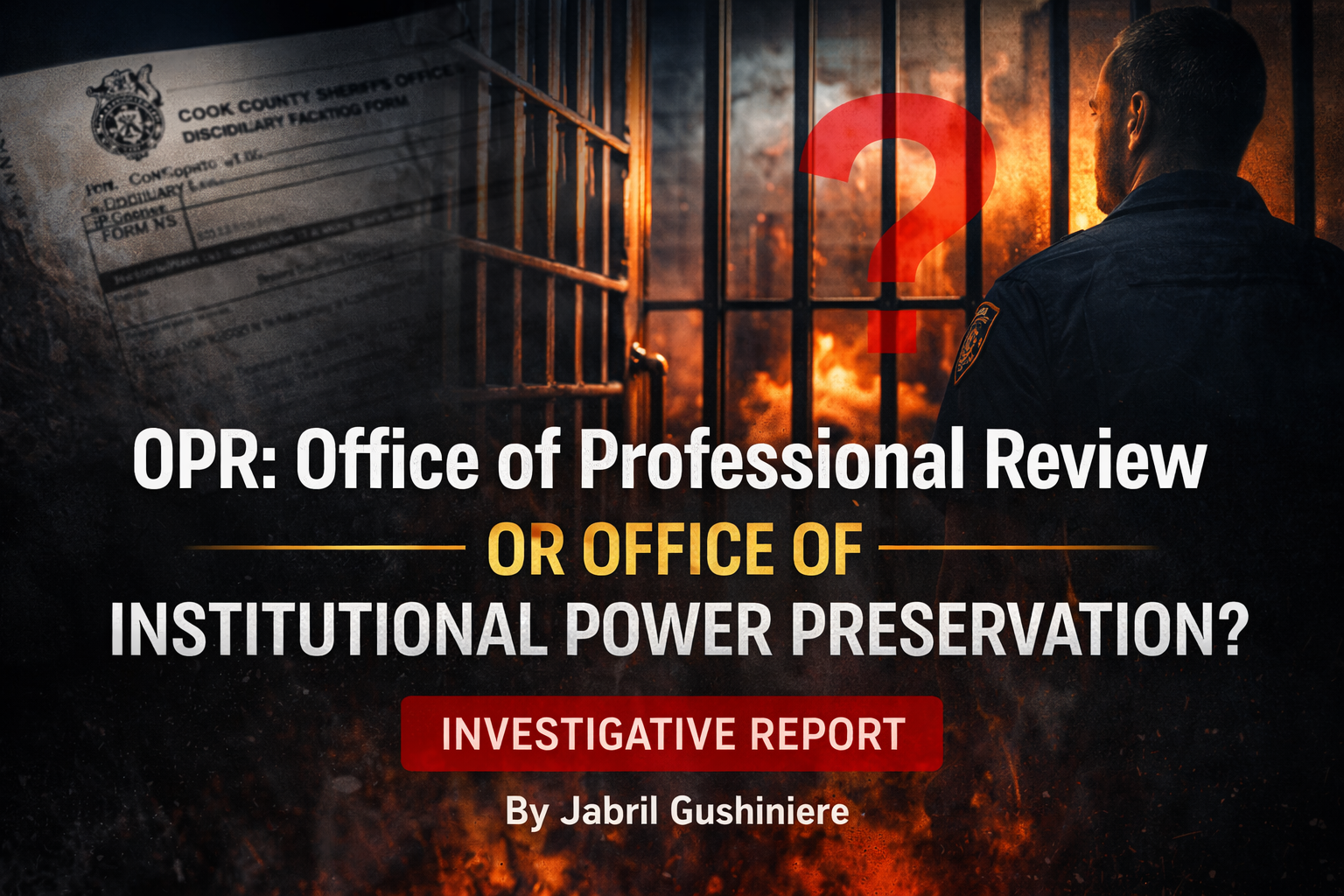
OPR: Office of Professional Review - Or Office of Institutional Power Preservation? What Do They Really Stand For?
The Real Test of Accountability
Internal oversight bodies only prove their integrity when complaints move upward.
When a correctional officer is accused of misconduct, the disciplinary system knows how to move. Reports are written. Investigations open. Findings are issued. Punishment is considered. The machinery functions.
But what happens when the complaint is against a supervisor? What happens when the evidence cuts against a lieutenant, a director, or the administration itself? What happens when the person invoking the accountability system is not the problem, but the witness?
That is where the real test begins.
This article is about the Cook County Sheriff’s Office Office of Professional Review — OPR — the internal body that is supposed to investigate misconduct and ensure accountability. On paper, that is its purpose. In practice, the record raises a far more serious question: is OPR actually reviewing misconduct, or is it protecting institutional power by shielding supervisors, directors, and administrative interests from consequence?
My case is the roadmap.
It involves dangerous RTU assignments, protected protest of cross-watching, retaliatory timing, video evidence, a grievance victory, an arbitrator’s confirmation, written findings, and a paper trail that OPR reframed. If this can happen when the truth is on tape, it can happen to anyone inside the system.
What OPR Is Supposed to Be - And What It Appears to Be
The Office of Professional Review is supposed to be the internal accountability arm of the Cook County Sheriff’s Office. It is supposed to investigate misconduct, follow evidence, and apply professional standards across the chain of command.
That is the public-facing version.
On paper, OPR’s role is professional review. In practice, officers have repeatedly described something else: when complaints move toward supervisors, administrators, or directors, the outcomes often appear to favor institutional preservation over consequence.
Internal oversight carries a structural conflict that cannot be ignored. The office charged with investigating misconduct operates inside the same institution whose leadership may be implicated by the facts. It is expected to expose wrongdoing while remaining embedded in the very hierarchy that benefits from minimizing it.
That is where corruption can become institutional.
Corruption is not always a bribe or an indictment. Sometimes it takes the form of a system that absorbs complaints, softens findings, reframes facts, and preserves the people most valuable to the institution.
When that happens, accountability becomes performance.
And performance is not justice.
February 3, 2022: The Cross-Watch Dispute That Started It
On February 3, 2022, I was assigned to RTU tier 5A and then told I would also be assigned to 5B.
That is not a minor detail. It is the beginning of the entire story.
RTU 5A is known as “the hole.” Both 5A and 5B are maximum-security RTU tiers used for some of the most difficult-to-manage detainees in custody. The danger of those tiers is not hypothetical. In later years, Cook County saw multiple serious incidents on those very tiers, including deaths and a fatal cell fire. That is relevant context because it underscores why cross-watching there was not a casual administrative inconvenience. It was a safety issue.
I objected.
My position was not simply that I did not like the assignment. My position was that forcing one officer to cross-watch those tiers was unsafe, and that protesting cross-watching was already protected concerted activity under the Janda/Bollinger Illinois Labor Relations Board ruling.
The sergeant relayed the assignment, but the lieutenant controlled it. When I refused, I was effectively refusing the lieutenant’s directive. I was then told that if I would not cross-watch, I would have to go home.
I responded that this made no sense. If the division was claiming it was short-staffed, then it made no sense to send an officer home for refusing an unsafe assignment. Relief was eventually sent — and, significantly, two people arrived.
That matters.
Because someone acting on my behalf then contacted higher command — the superintendent and the executive director — to inform them that the lieutenant was attempting to send me home for refusing to cross-watch. According to my account, the superintendent agreed I should be sent home, but the executive director overruled that decision and directed that it made no sense to send me home if the division was truly short-staffed. Instead, I was assigned to one tier.
That tier was 3H.
That sequence is critical because it shows something simple: once the situation moved higher up the chain, even management recognized that the original “send him home” logic was difficult to defend.
The Next Assignment, the Fight, and the Write-Ups
After the cross-watch dispute, I returned to work and was assigned to tier 3H.
My position, and my later complaint, was that I was on the tier during medication pass and that when a fight broke out in the bathroom, I responded and helped break it up.
The next day, I received the write-ups that now sit at the center of this article.
There were two disciplinary action forms, both dated February 3, 2022.
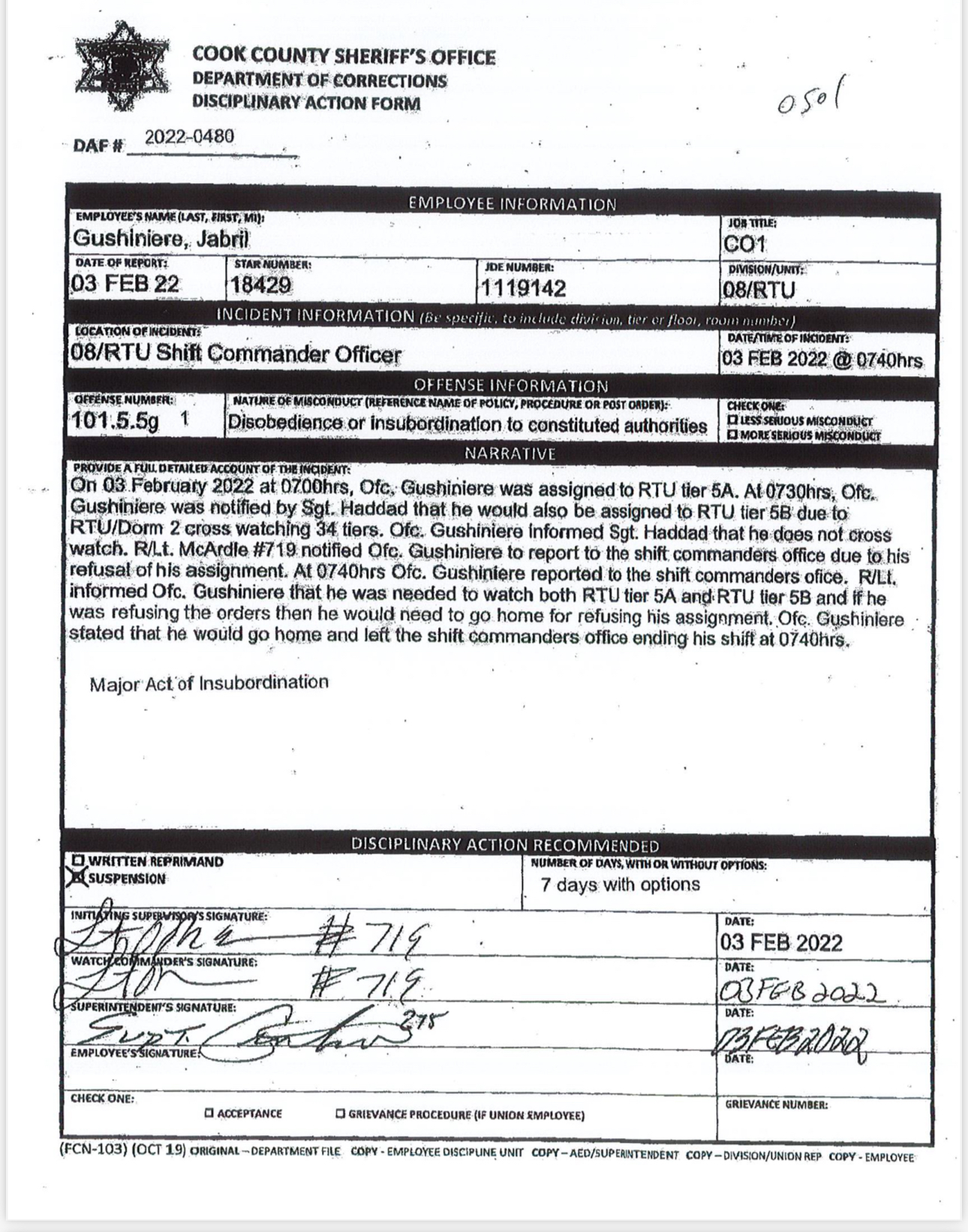
The first, DAF #2022-0480, accused me of insubordination tied to my refusal to cross-watch.
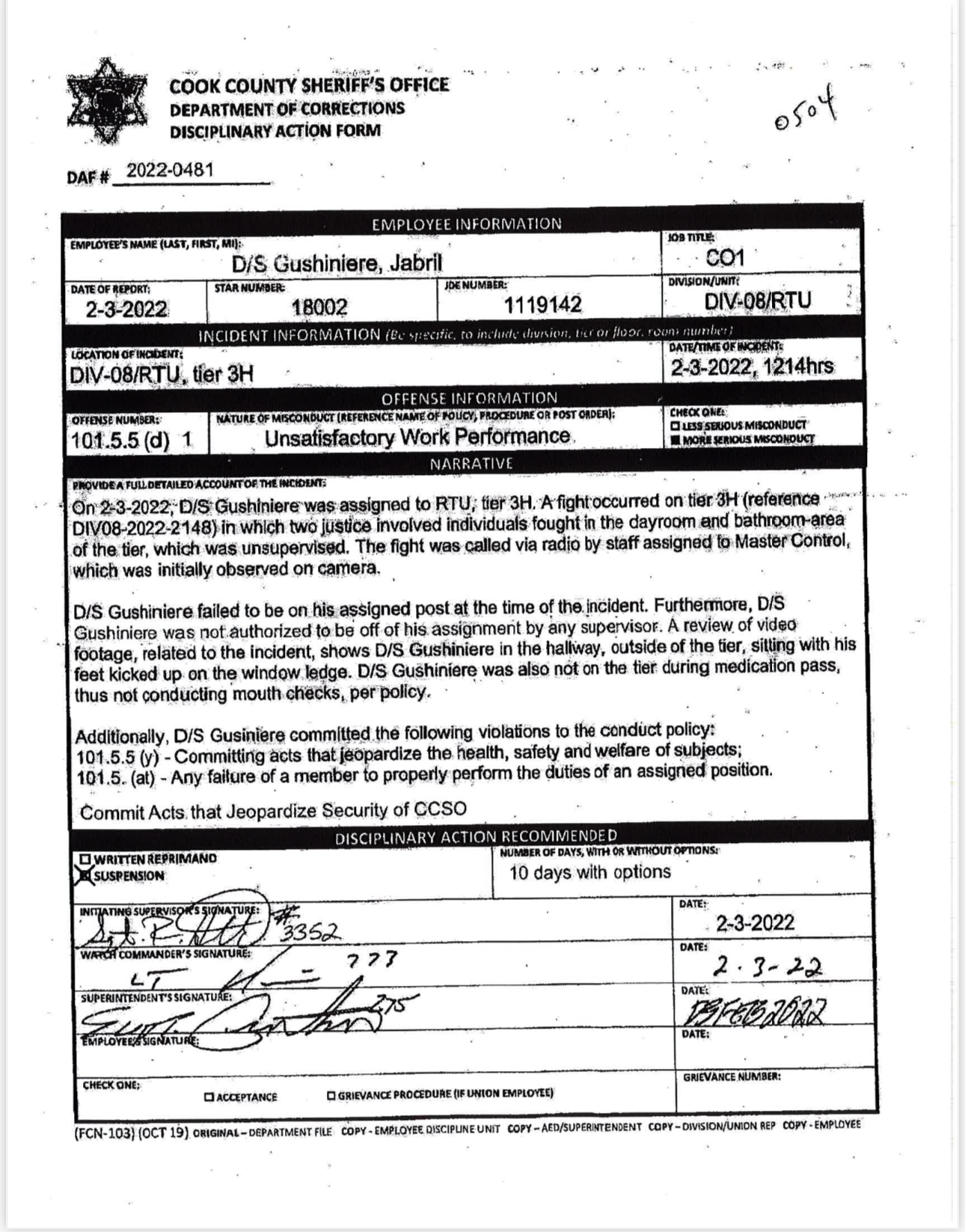
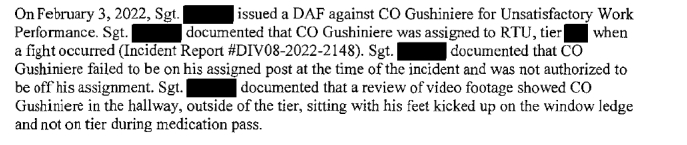
The second, DAF #2022-0481, accused me of unsatisfactory work performance and alleged that during the 3H fight I was outside the tier with my foot or feet kicked up on the window ledge rather than on my post.
That timing matters.
According to my complaint, these write-ups came less than 24 hours after I protested cross-watching as unsafe and improper. One punished the protest itself. The other, in my view, fabricated a false narrative about what happened on 3H.
That is why this case matters. It is not just about one bad write-up. It is about how protected protest, retaliatory timing, and institutional review all fit together.
The Video vs. the Narrative: How OPR Reframed the Facts
This is where the article stops being opinion and becomes evidence.
The accusation in DAF #2022-0481:
I was outside the tier with my foot or feet kicked up on the window ledge during a fight.
What OPR later said the video showed:
I was at the threshold of the tier door, which supervisory staff may have interpreted as me not being on my assignment.
These are not two ways of describing the same event.
They are two different factual claims.
An officer at the threshold of the tier door is not the same as an officer outside the tier with his feet kicked up while detainees fight. One description places an officer at or near his post. The other paints an officer as detached from duty and deserving of discipline.
Those descriptions could not honestly be confused.
One is the truth supported by video.
The other is a disciplinary narrative.
That distinction is where institutional protection becomes visible.
Because when OPR was confronted with a contradiction that cut against supervisors, it did not treat the contradiction as grounds for accountability. It converted it into something softer — an interpretation, a misunderstanding, a survivable administrative explanation.
That is not accountability. It is institutional protection.
When an office charged with reviewing misconduct is presented with a falsifiable accusation contradicted by video evidence and still finds a way to preserve supervisory credibility, the problem is no longer just a bad report. The problem is the integrity of the investigative body itself.
The Grievance Was Granted - But It Took Nearly Two Years
The grievance process reviewed the incident and the evidence.
The grievance was granted.
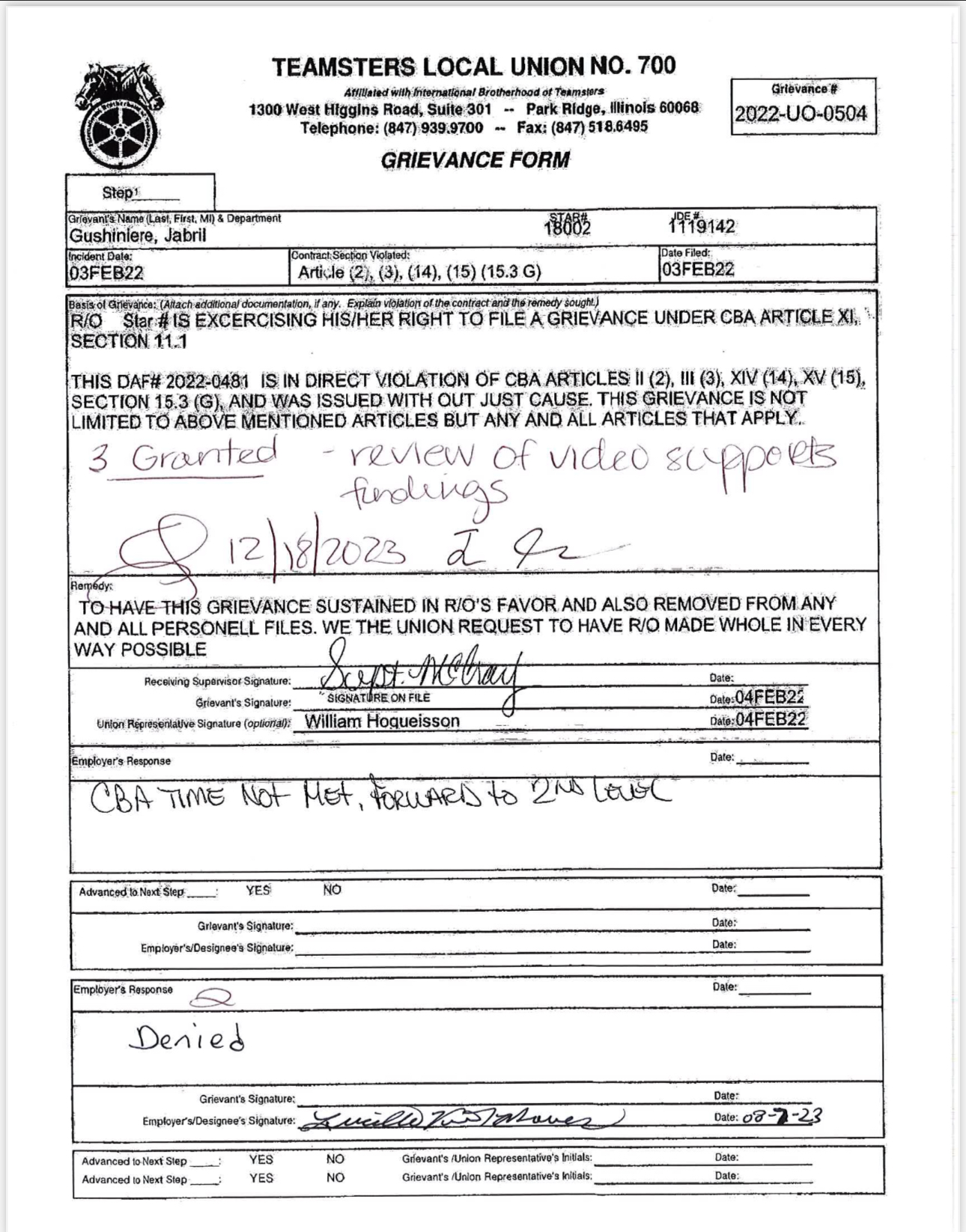
The grievance record contains a notation reflecting that at Step 3, the grievance was granted and that review of video supports findings, with the date December 18, 2023.
That means something important.
I was written up on February 3, 2022. My grievance victory did not come until December 18, 2023.
In other words, it took more than twenty-two months - and multiple grievance steps - for the system to acknowledge what video evidence could have shown much earlier.
An independent arbitrator ultimately confirmed what the video already made clear: the narrative used against me did not withstand honest review. The supervisors’ account did not hold up, and the evidence supported my position.
I won. But the truth did not reach the people who should have been held accountable for the unsupported narrative.
That should have been the turning point.
It should have triggered accountability for the supervisors who authored the narrative. It should have triggered scrutiny of the office that declined to treat the contradiction directly. It should have forced a correction inside the system.
It did not.
The issue is not merely that I beat the case. The issue is that even after the case was beaten, even after the evidence supported me, the people who created the unsupported narrative were not meaningfully held accountable by the office that exists to hold people accountable.
That raises the institutional protection question.
If video evidence and grievance review can expose an unsupported disciplinary narrative, yet no real consequence reaches the supervisors responsible for it, what exactly is OPR doing? Reviewing misconduct — or reframing it into administrative ambiguity?
Because that is what happened here. A documented contradiction was softened into an interpretation, and the people with rank were protected from the consequence the evidence demanded.
The Cross-Watch Write-Up and the ILRB Problem
The first write-up, DAF #2022-0480, matters just as much.
That disciplinary action framed my refusal to cross-watch as insubordination. But by then, Cook County had already been confronted with the labor-law implications of punishing officers for protesting cross-watching.
The Illinois Labor Relations Board notice in Case No. L-CA-21-033 stated that the County and Sheriff violated the Illinois Public Labor Relations Act and were ordered to cease and desist from threatening and retaliating against employees in response to the protected protest of cross-watching. The notice also stated that the County and Sheriff would withdraw and dismiss the complaint register and OPR investigation initiated because of that protected concerted activity and expunge the related record from employment files.
That context matters immensely.
It means the issue was not merely operational. It had already been recognized as a labor-rights problem.
So, when I was written up for protesting cross-watching on maximum-security RTU tiers, I viewed that write-up as not just unfair, but as directly conflicting with the labor-rights protections that had already been established.
That is why the two DAFs should not be read separately. One targeted the protest itself. The other targeted my character and performance immediately after the protest.
Together, they tell a much clearer story.
Michael Cooke, Deborah Simental, and the Leadership Question
At the time my complaint was handled, the Director of OPR was Michael Cooke.
Today, the Director of OPR is Deborah Simental.
Those names matter because leadership matters.
This article is not claiming that one person alone created the problem. The problem is larger than a single director. But directors are responsible for the office they run, the patterns that persist under their authority, and the investigative culture that office either tolerates or corrects.
Under Michael Cooke’s leadership, OPR handled a complaint involving a disciplinary narrative contradicted by video evidence and failed to convert that contradiction into accountability for supervisors.
Under Deborah Simental’s leadership, from my perspective, the broader pattern of institutional protection remains. The names may change. The function does not.
This is not merely about personalities. It is about an office whose leadership has not broken with a pattern of protecting administrative agenda over evidence-based outcomes.
And that question cannot stop at the director’s office.
Sheriff Tom Dart has spent years cultivating a public image as a reformer. But internal accountability is where reform is tested, not where it is advertised. If OPR repeatedly preserves supervisors when evidence cuts against them, then the question is no longer whether individual investigators failed. The question is what kind of accountability culture the Dart administration has built, tolerated, or allowed to persist.
Marcia Oviedo, CPD, and the Damage That Follows Officers Even After They Win
The institutional protection did not end when the grievance was granted.
According to my records, Marcia Oviedo was involved in sending OPR-related records to outside employers, including the Chicago Police Department, even when charges were not sustained or had already been defeated.
That matters enormously.
Because the injustice of an unsupported accusation does not stop at the write-up. It can continue through the circulation of records that preserve damage even after the truth has been established. In my case, the very matters discussed here — the cross-watch and 3H disciplinary issues — were still transmitted outward even though the underlying accusations did not ultimately hold up under grievance review.
The timing is one of the most disturbing parts of this story.
My grievance victory came on December 18, 2023.
But the CPD-related material tied to these disciplinary matters was transmitted and relied upon on December 4, 2023 - roughly two weeks before my grievance victory.
So unresolved or not-yet-vindicated disciplinary material was sent outward and used against me before the internal process finally moved in my favor.
That is why I view it as sabotage.
Why would unresolved discipline be sent into an outside employment process before the grievance was decided? Why would unsupported narratives be allowed to travel before the truth caught up?
That is not accountability. That is contamination. That is administrative records extended through paperwork.
This is more than recordkeeping. It resembles a shadow personnel file — a system in which defeated or unsustained allegations continue to travel beyond the institution and affect an officer’s future even after the evidence clears him. At what point does that become institutional blacklisting?
And when unresolved, unsustained, or later-defeated matters can still be sent to outside agencies in ways that harm officers, the system is no longer just investigating misconduct. It is extending its reach through records.
I Took Evidence of OPR Concerns Outside OPR
At a certain point, internal trust collapses.
When the office charged with accountability reframes evidence in ways that protect supervisors, the only rational move is to go outside the immediate power structure.
I did exactly that.
I contacted the Cook County Office of the Independent Inspector General and raised concerns involving retaliation and patterns tied to OPR. The investigator assigned to communicate with me was Majed Assaf.
This was not a vague complaint. I was asked to provide documentation concerning my claims. I provided evidence. I asked whether work emails could be submitted as supporting documentation. I was told they could, so long as I gave context. I then forwarded original-source work emails and other materials that I identified as supporting claims of misconduct and retaliation within OPR and the broader administration. I also sent my Unicorn Riot exposé and supporting evidence trail.
That matters because it destroys any suggestion that I was merely venting or making unsupported accusations. I brought records. I brought documentation. I brought chronology. I brought the exact type of evidence an outside oversight office should want if it genuinely intends to investigate concerns.
An interview was scheduled for May 12, 2025.
That is where the next layer of the process emerged.
Majed Assaf and the OIIG Did Not Behave Like an Office Eager to Investigate Concerns
The sequence is difficult to ignore.
I brought OPR concerns to the OIIG. Majed Assaf requested evidence. I sent work-email evidence and the Unicorn Riot material. An interview was scheduled for May 12, 2025.
Then, on the morning of that interview — less than two hours before it was set to begin - Assaf sent me interview agreements and instructed me to sign and return them before the interview commenced.
Those documents were not trivial. They included confidentiality terms, video-conferencing restrictions, and warnings about how the interview could be used. Their practical effect was unmistakable: they sought to control the conditions under which I could speak, document, preserve, and later reference the interview I had initiated in good faith.
While confidentiality and no-recording clauses are standard OIIG interview templates, the timing — sent less than two hours before the scheduled interview — and the cancellation after I asserted my right to document the conversation for personal protection raised legitimate concerns about transparency in an inquiry I had initiated.
I objected in writing. I made clear that the forms had been sent too late for legal review and that several provisions appeared to limit my rights, including my ability to document, protect, and report concerns in an investigation I had voluntarily initiated.
I also made clear that I intended to record the interview for my own protection, to preserve accuracy, and to maintain a transparent record.
When I refused to surrender one-sided control of the record, the virtual interview was canceled.
Once it became clear that I was bringing original-source evidence and a public evidence trail — including the Unicorn Riot exposé and evidence vault — into the process, the OIIG’s posture appeared to shift from review to restriction.
The pattern was difficult to miss: once I insisted on preserving an independent record of my allegations, the process stopped moving like an investigation and started moving like containment.
That is not what an office looks like when it wants the truth.
That is what an office looks like when it wants control over the truth.
Once I Refused Their Terms, the Matter Went Quiet
The context matters even further.
I explained to Majed Assaf that I was scheduled to work on the Monday the interview was set to occur. At that point, the interview had been communicated to me as an in-person meeting, not a Zoom meeting — a fact reflected in the email directing me to arrive 15 minutes early to account for parking. I then informed HR that OIIG had indicated Cook County could not prevent me from attending the interview, and I forwarded the relevant OIIG messages. After that, I was contacted by OIIG by telephone and told I was mistaken and that the interview was actually a Zoom meeting. That was a clear shift from what had previously been communicated. It was after that reversal — not after the later recording dispute — that I made clear all further communication needed to be documented in writing. Then, on the day of the interview, OIIG sent the restrictive interview documents and attempted to impose those conditions on an interview I had voluntarily arranged. When I refused to accept those last-minute terms, the office did not move the matter forward and ultimately ignored my follow-up communications altogether.
That silence matters.
Because this was not silence in response to a casual inquiry. It was silence in response to concerns involving the internal body charged with accountability. It was silence after evidence had been submitted, after an interview had been scheduled, and after I refused to accept restrictive conditions imposed at the last moment.
The result was unmistakable: when I brought evidence of concerns within OPR to the outside oversight channel, the energy of the process shifted from investigating the allegations to controlling the conditions under which I could tell the story.
That is why this article does not treat the OIIG episode as an isolated procedural disagreement. It is part of the pattern.
When even the external route appears more concerned with containment than exposure, the accountability crisis is not merely internal to OPR. It is systemic.
C4 Has Seen the Pattern Repeated Through Other Officers’ Accounts
This article does not rest on my case alone.
Through the Cook County Corrections Coalition, we have compiled evidence and accounts from officers who reported filing complaints on supervisors involving harassment, bullying, sexual harassment, administrative abuse, and retaliation.
And the outcomes they describe follow a familiar pattern.
Some officers report filing complaints and never hearing back from OPR at all.
Some report no findings, no closure, and no meaningful communication.
Some report that after filing a complaint on an administrator or director, they themselves became the target of an investigation by OPR.
Officer accounts compiled by C4, with names withheld where necessary for safety, describe the same recurring structure: a complaint is filed upward, the process goes quiet, or the reporting officer suddenly becomes the subject.
The details may vary. The function does not.
An officer reports misconduct by someone above him.
The process goes quiet.
Or the process turns around.
Or the reporting officer becomes the subject.
That is not a healthy accountability culture. That is a culture that teaches officers a dangerous lesson: do not expect protection when your complaint threatens rank.
A complaint system that goes silent when officers report supervisors is not merely ineffective. It is a system that teaches employees that accountability depends on rank.
And once officers learn that lesson, silence becomes rational.
That silence is not evidence that misconduct is rare. It is evidence that fear, futility, and institutional distrust have become normal.
That is how institutional protection survives inside public systems.
Cook County’s History Makes This Even More Serious
Cook County does not operate free from history.
It is a governmental environment with a long and public history of corruption allegations, patronage, institutional protection, and systems that have too often appeared more committed to self-preservation than honest accountability.
That history matters because every internal review body operating in Cook County inherits a burden it cannot ignore: it must prove that it is not simply another mechanism through which power protects itself.
That burden is heightened, not reduced, when the office in question is charged with investigating misconduct.
In a county with that history, oversight must be stronger, cleaner, and more transparent than average - not weaker, more selective, and more opaque.
So, when OPR appears to preserve supervisors from documented contradiction, when the OIIG appears to impose last-minute restrictions on a whistleblower bringing evidence of concerns within OPR, and when multiple officers report complaints disappearing or boomeranging back on them, the public is entitled to stop pretending these are random anomalies.
At some point, the phrase institutional protection becomes the accurate description.
Not because it sounds dramatic.
Because the pattern earns it.
The Institutional Protection Question OPR Cannot Escape
The central question in this article is not complicated.
If supervisors can author disciplinary narratives contradicted by video evidence, and OPR still finds a way to preserve them, what should that be called?
If an officer can win his grievance, prove that the narrative used against him did not hold up, and still watch records from that matter follow him to outside agencies, what should that be called?
If officers can file complaints involving harassment, bullying, sexual harassment, retaliation, and administrative abuse, only to hear nothing back or become targets themselves, what should that be called?
If a whistleblower can bring evidence of concerns involving OPR to the Office of the Independent Inspector General, only to be met with last-minute confidentiality terms, anti-recording restrictions, cancellation once documentation is insisted upon, and then silence, what should that be called?
Is it accountability?
Or is it institutional protection within the very structure meant to expose it?
The evidence in my case points in one direction. The broader pattern reported by other officers’ points in the same direction.
That is why this article is not asking a reckless question. It is asking the only honest one left.
What OPR Really Stands For
On paper, OPR still stands for Office of Professional Review.
But institutions are not defined by their titles. They are defined by what they repeatedly do.
If OPR preserves supervisors when evidence cuts against them…
If OPR reframes documented contradiction into harmless interpretation…
If OPR allows unsupported narratives to outlive the evidence that defeats them…
If OPR participates in a system where records can continue affecting officers after those officers prevail…
If OPR is the source of so many officer accounts describing silence, redirection, and retaliation…
Then the title no longer matches the function.
That is why the alternative in this article is not rhetorical flair.
It is descriptive.
Office of Institutional Power Preservation.
Because that is what the evidence suggests OPR has become.
Not an office that follows evidence wherever it leads.
An office that absorbs evidence, neutralizes it, and protects the people most dangerous for the institution to expose.
That is what happened in my case.
That is what other officers describe in theirs.
And that is why the public, correctional officers, the media, and every honest oversight authority should stop accepting the branding and start examining the function.
The Demand
This article is not a request for sympathy.
It is a demand for accountability.
The Cook County Sheriff’s Office should be forced to answer basic questions.
How many officer complaints against supervisors has OPR received?
How many were sustained?
How many involved harassment, bullying, sexual harassment, retaliation, or administrative abuse?
How many officers who filed complaints later became subjects of investigation themselves?
Why are records from unsustained or defeated matters sent to outside employers?
Why should any officer trust a system that preserves unsupported narratives once they rise high enough in rank?
What is the total cost to Cook County taxpayers for defending disciplinary actions that are overturned once independent arbitrators view the actual video evidence?
How much public money has been spent defending unsupported or overturned disciplinary actions that collapse once subjected to independent review?
C4 has filed FOIA requests seeking these statistics. Until full disclosure exists, the officer accounts and documentary evidence already in the record fill the gap the administration refuses to close.
And the Office of the Independent Inspector General should answer its own questions as well.
Why were restrictive interview documents sent moments before an interview about concerns involving OPR?
Why was lawful documentation treated as a problem instead of a safeguard?
Why did the process stall once transparency was demanded?
If these offices want public confidence, they should welcome those questions.
If they resist them, that resistance will answer the article more clearly than any official statement ever could.
Because institutional protection thrives where evidence is managed instead of confronted.
The public does not need another mission statement from OPR. It needs an answer to the record. If supervisors can author unsupported narratives, if video can contradict them, if grievances can vindicate officers, if records can still be extended afterward, and if outside oversight stalls once documentation is demanded, then the issue is no longer whether OPR has a credibility problem. The issue is whether OPR has become exactly what this article names it: an Office of Institutional Power Preservation.
Exhibits and Supporting Material
This article is supported by documentary evidence, including the following exhibits. Certain exhibits are presented here as single images. Additional related records, full chains, and supplemental multi-page materials are available upon request.
Single-Image Exhibits Included With This Article
Exhibit A — Teamsters Local 700 Grievance Form (Grievance No. 2022-UO-0504)
Grievance form reflecting the challenge to DAF #2022-0481, including the handwritten notation indicating that Step 3 was granted and that review of video supports findings, dated December 18, 2023.
Exhibit B — Disciplinary Action Form #2022-0481
Cook County Sheriff’s Office disciplinary form alleging unsatisfactory work performance and asserting that video showed me outside the tier with my feet kicked up on the window ledge during the 3H incident.
Exhibit C — Disciplinary Action Form #2022-0480
Cook County Sheriff’s Office disciplinary form alleging disobedience / insubordination based on my refusal to cross-watch RTU tiers 5A and 5B on February 3, 2022.
Exhibit D — CPD / Human Resources Memorandum Dated December 4, 2023
Human Resources document showing that disciplinary material tied to DAF #2022-0480 and DAF #2022-0481 was transmitted into the Chicago Police Department hiring process before my grievance victory.
Exhibit E — OPR Findings Excerpt: Cross-Watch Allegation
OPR finding stating there was insufficient evidence to support my allegation that Lt. Gathright and Lt. McArdle illegally ordered cross-watching in violation of Sheriff’s policy.
Exhibit F — OPR Findings Excerpt: Fabrication / Retaliation Allegation
OPR finding stating there was insufficient evidence that Lt. Gathright and Lt. McArdle fabricated the DAF against me, while acknowledging that VSS footage captured me at the threshold of the tier door.
Exhibit G — OPR Findings Excerpt: Original Supervisory Narrative
OPR excerpt repeating the original disciplinary version that I was in the hallway, outside the tier, with my feet kicked up on the window ledge, demonstrating the contradiction between the original narrative and OPR’s later video-based characterization.
Exhibit H — Illinois Labor Relations Board Notice to Employees (Case No. L-CA-21-033)
Official ILRB notice ordering the County and Sheriff to cease and desist from threatening or retaliating against employees for protected protest of cross-watching and to withdraw and expunge related complaint-register and OPR records tied to that protected activity.
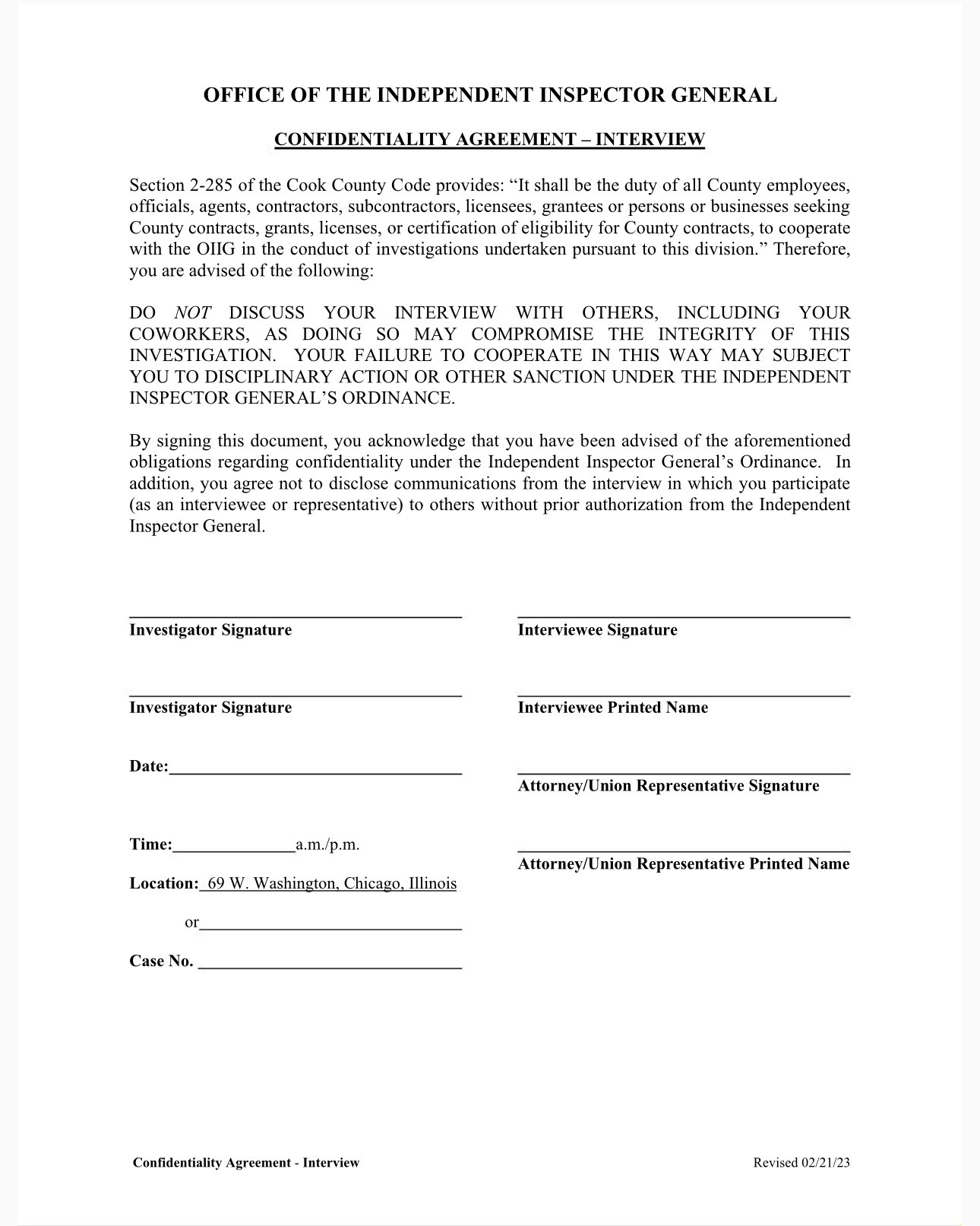
Exhibit I — OIIG Confidentiality Agreement – Interview
Cook County Office of the Independent Inspector General confidentiality agreement sent to me on the morning of the scheduled interview.
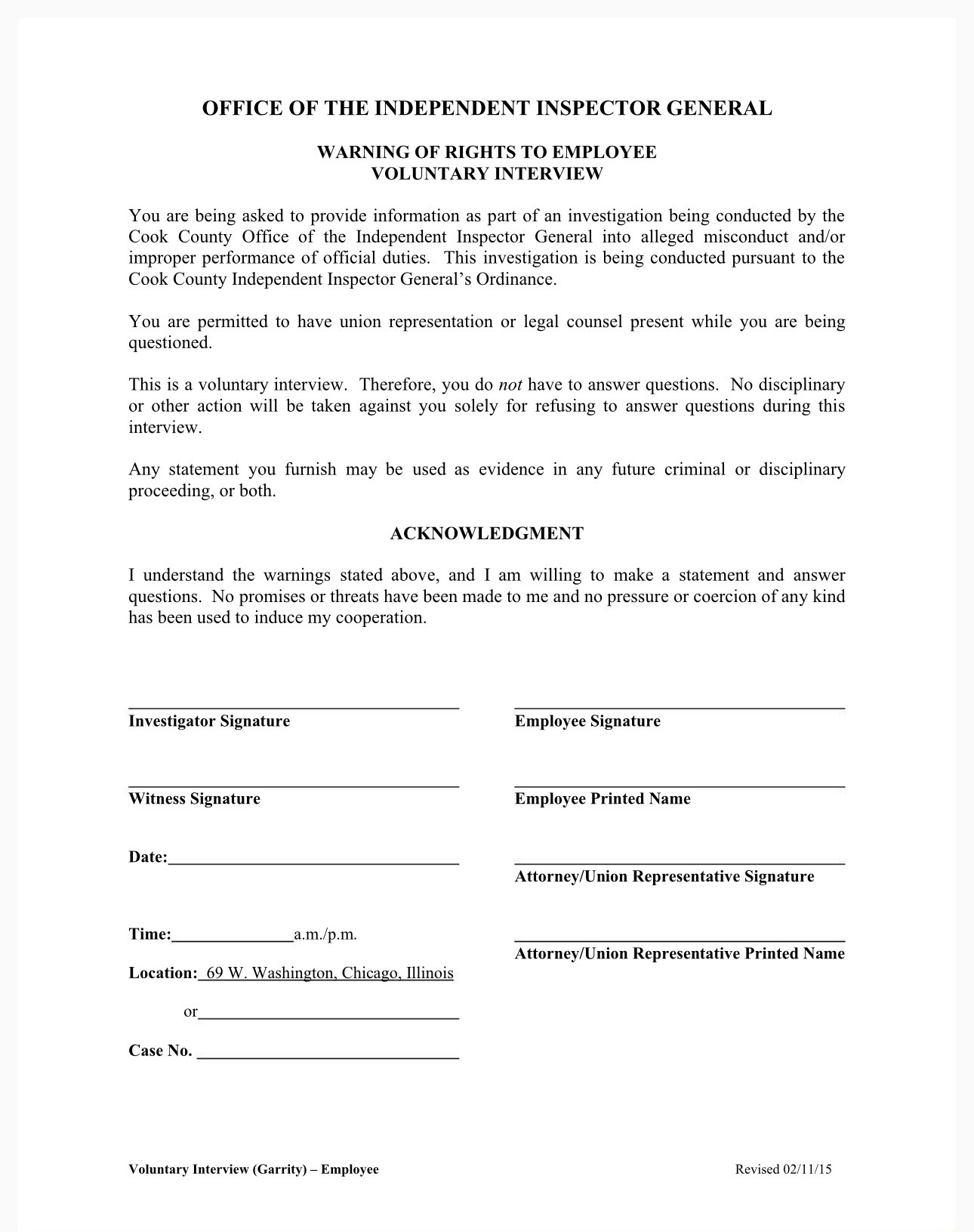
Exhibit J — OIIG Warning of Rights to Employee – Voluntary Interview
Cook County Office of the Independent Inspector General Garrity / voluntary interview warning form sent in connection with the scheduled interview.
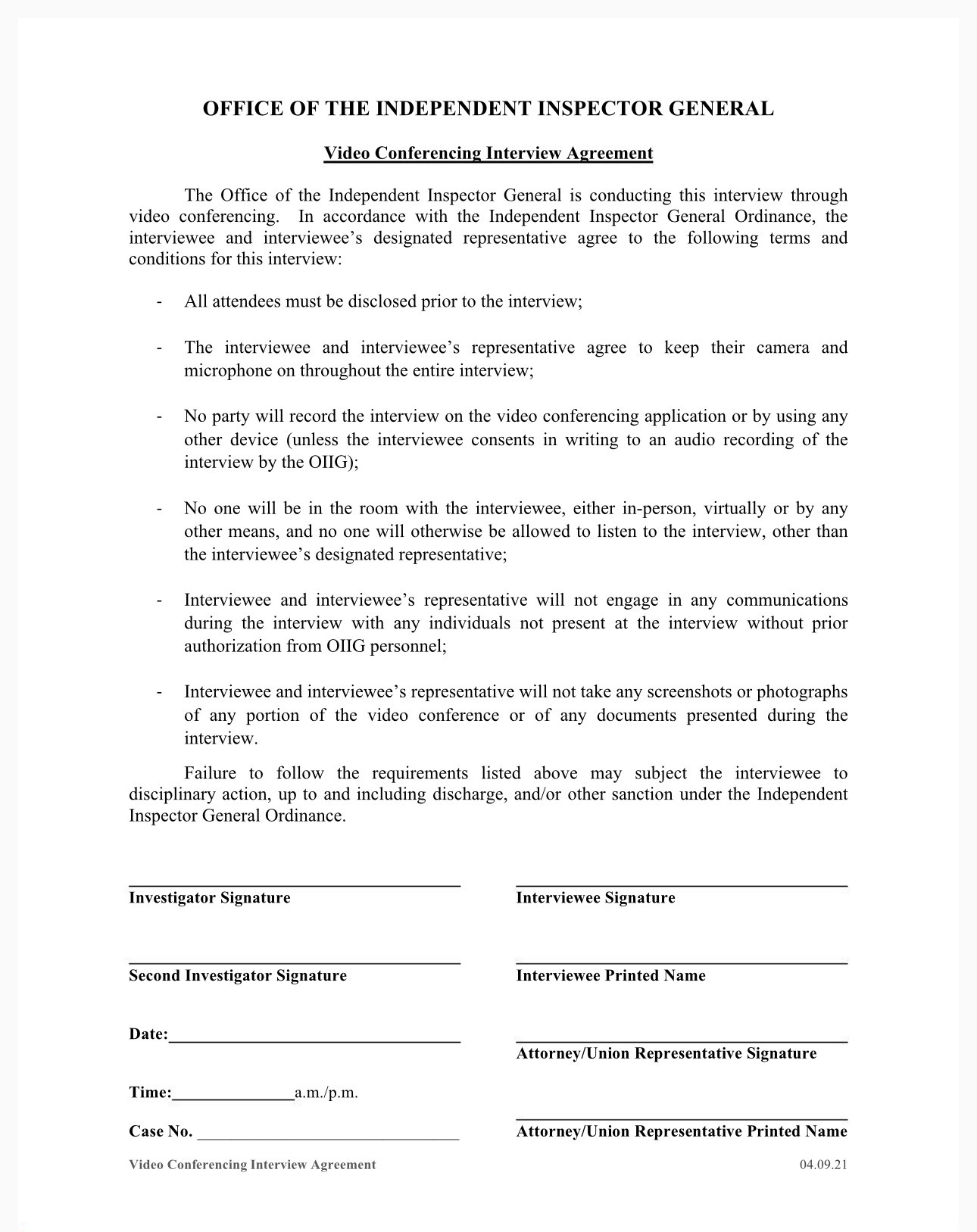
Exhibit K — OIIG Video Conferencing Interview Agreement
Cook County Office of the Independent Inspector General video interview agreement prohibiting recording, screenshots, and outside participation absent OIIG approval.
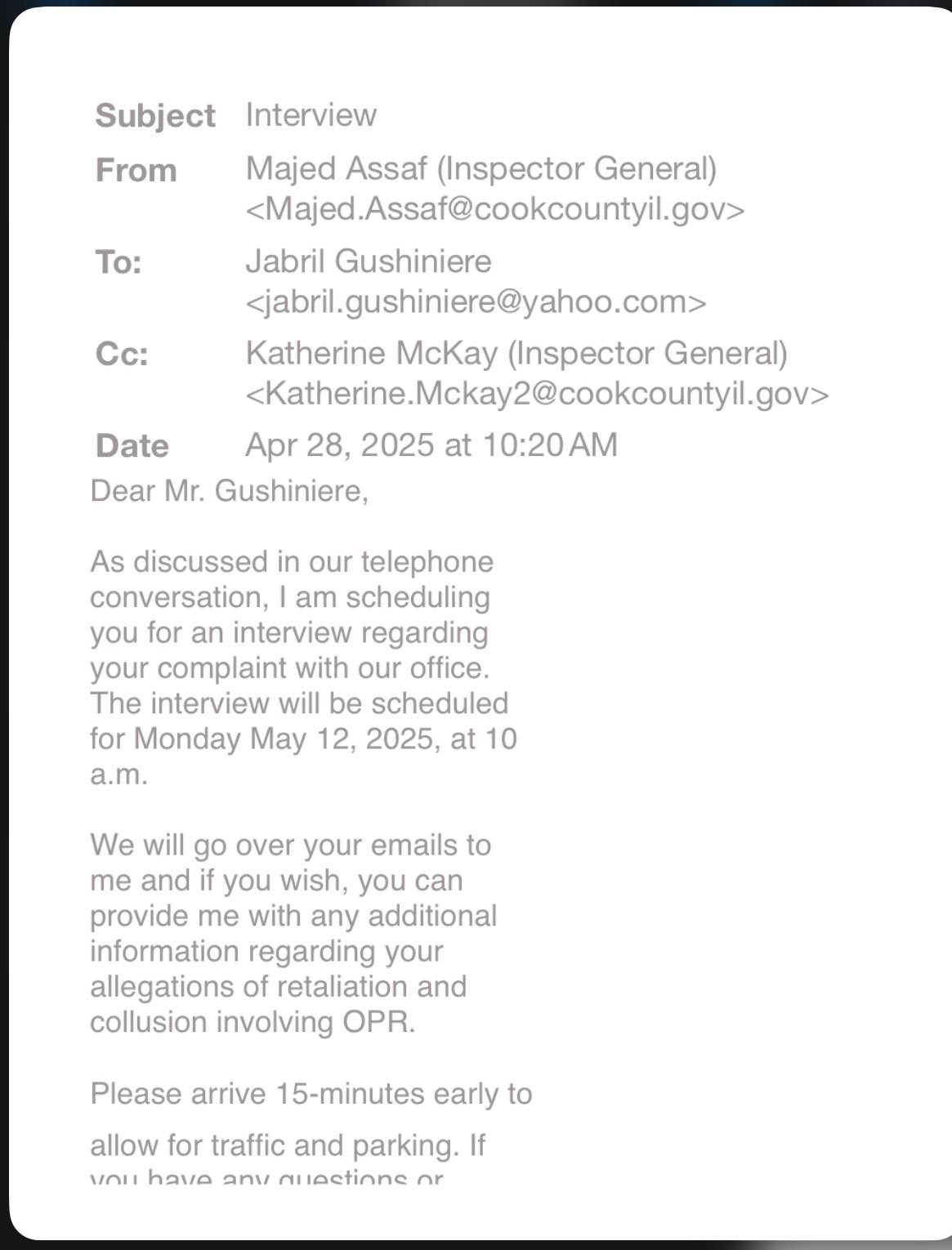
Exhibit L — OIIG Scheduling Email (April 28, 2025)
Email from Majed Assaf scheduling the interview for Monday, May 12, 2025 at 10:00 a.m. and instructing me to arrive 15 minutes early for traffic and parking, supporting my position that the interview was initially communicated as in person.
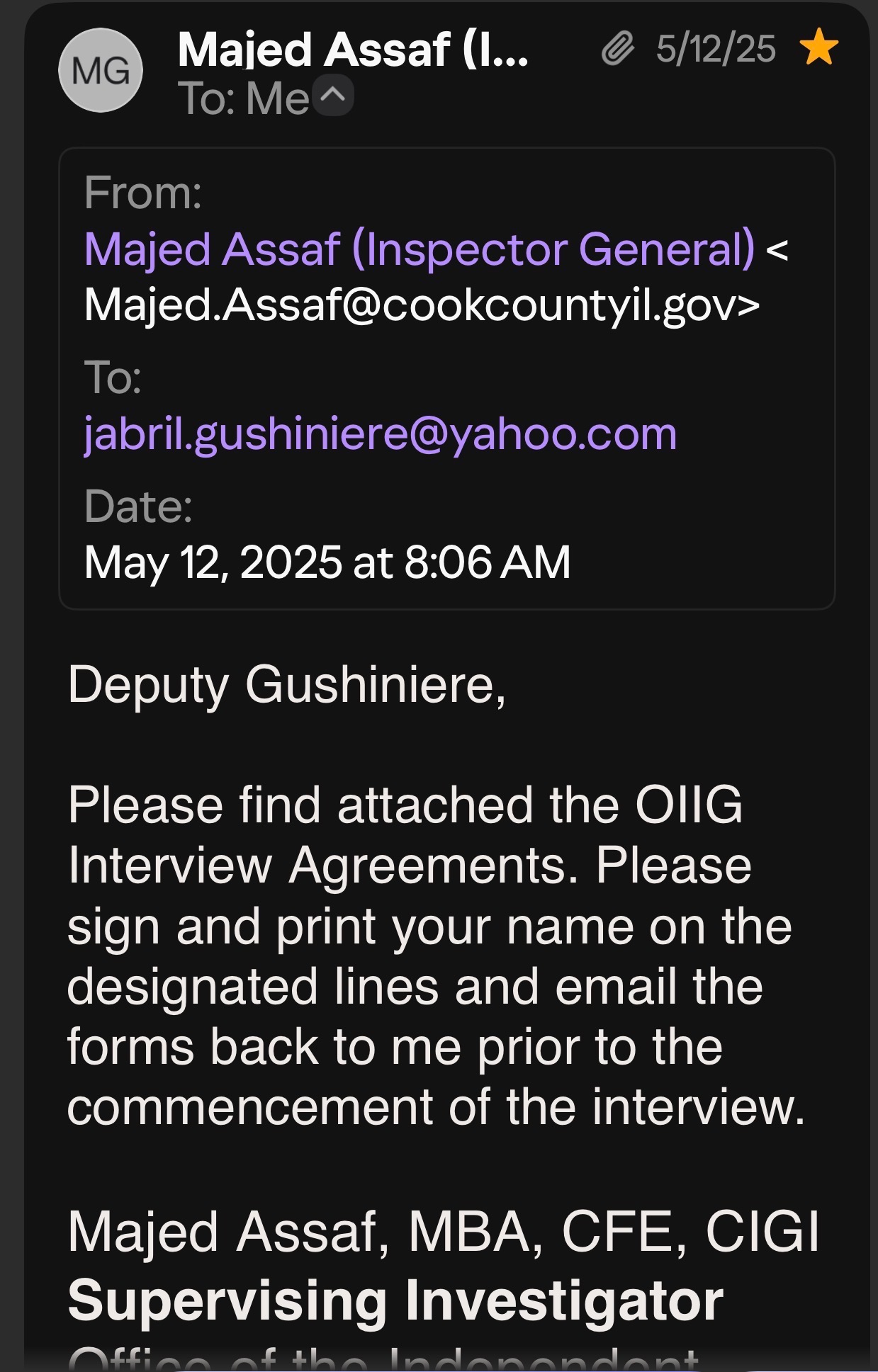
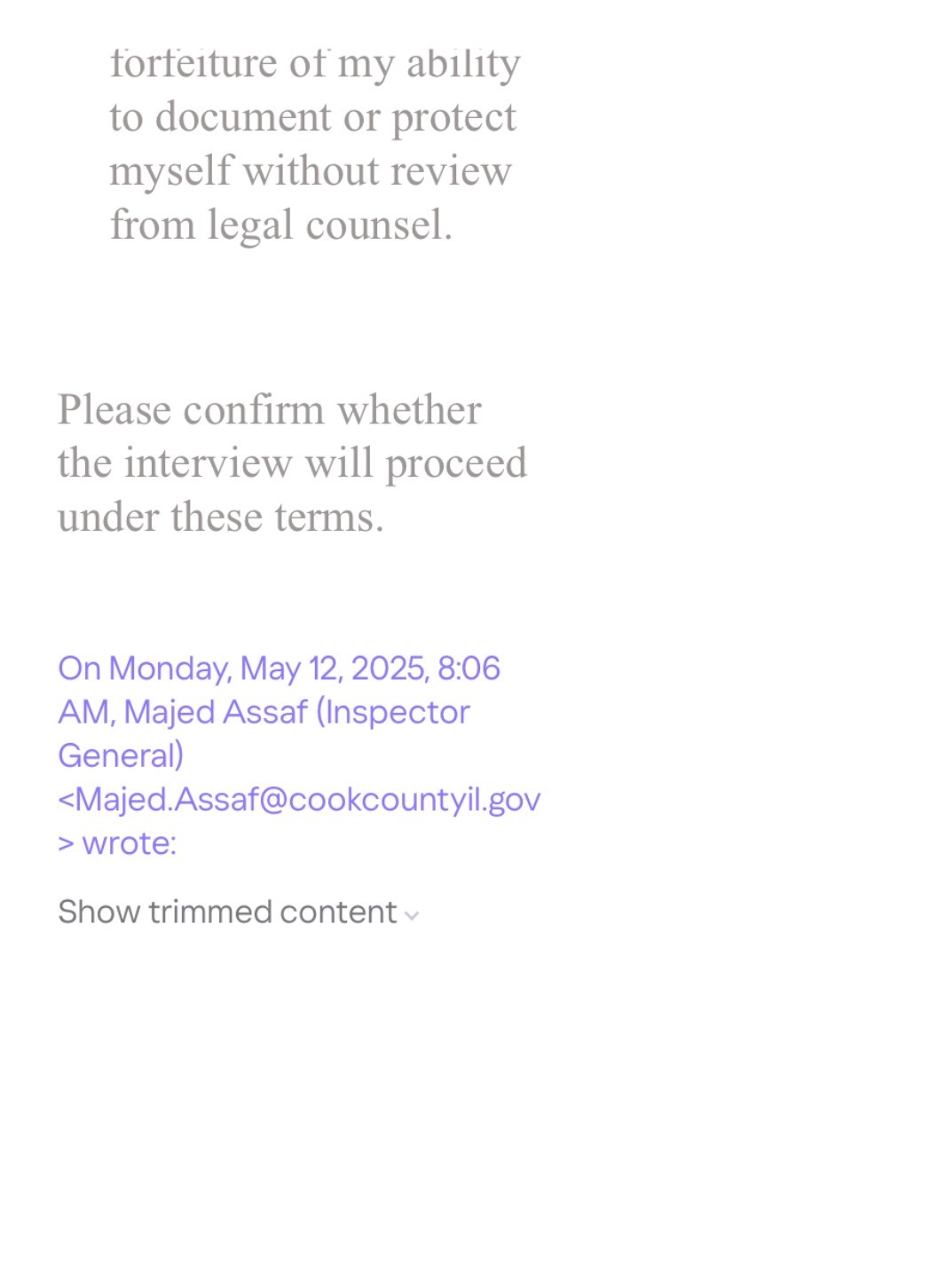
Exhibit M — OIIG Email Transmitting Interview Agreements (May 12, 2025, 8:06 a.m.)
Email from Majed Assaf forwarding the OIIG interview agreements less than two hours before the scheduled interview and directing that they be signed and returned before commencement.
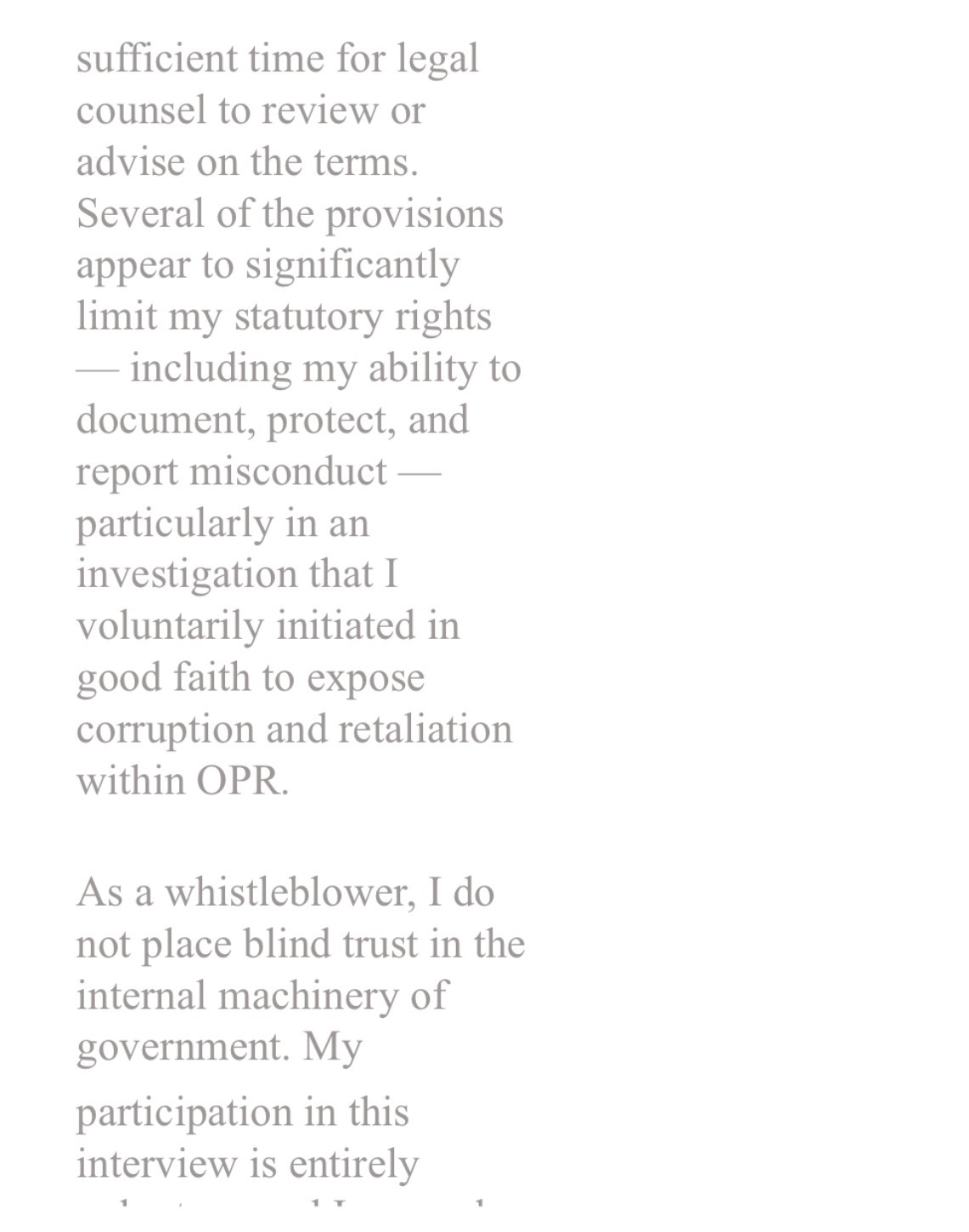
Exhibit N — My Written Response Objecting to the OIIG Agreements (Part 1)
First section of my written objection stating that I would not sign the agreements before the interview because they were sent too late for legal review.
Exhibit O — My Written Response Objecting to the OIIG Agreements (Part 2)
Second section of my written objection stating that several provisions appeared to limit my statutory rights, including my ability to document, protect, and report misconduct in an investigation I had voluntarily initiated.
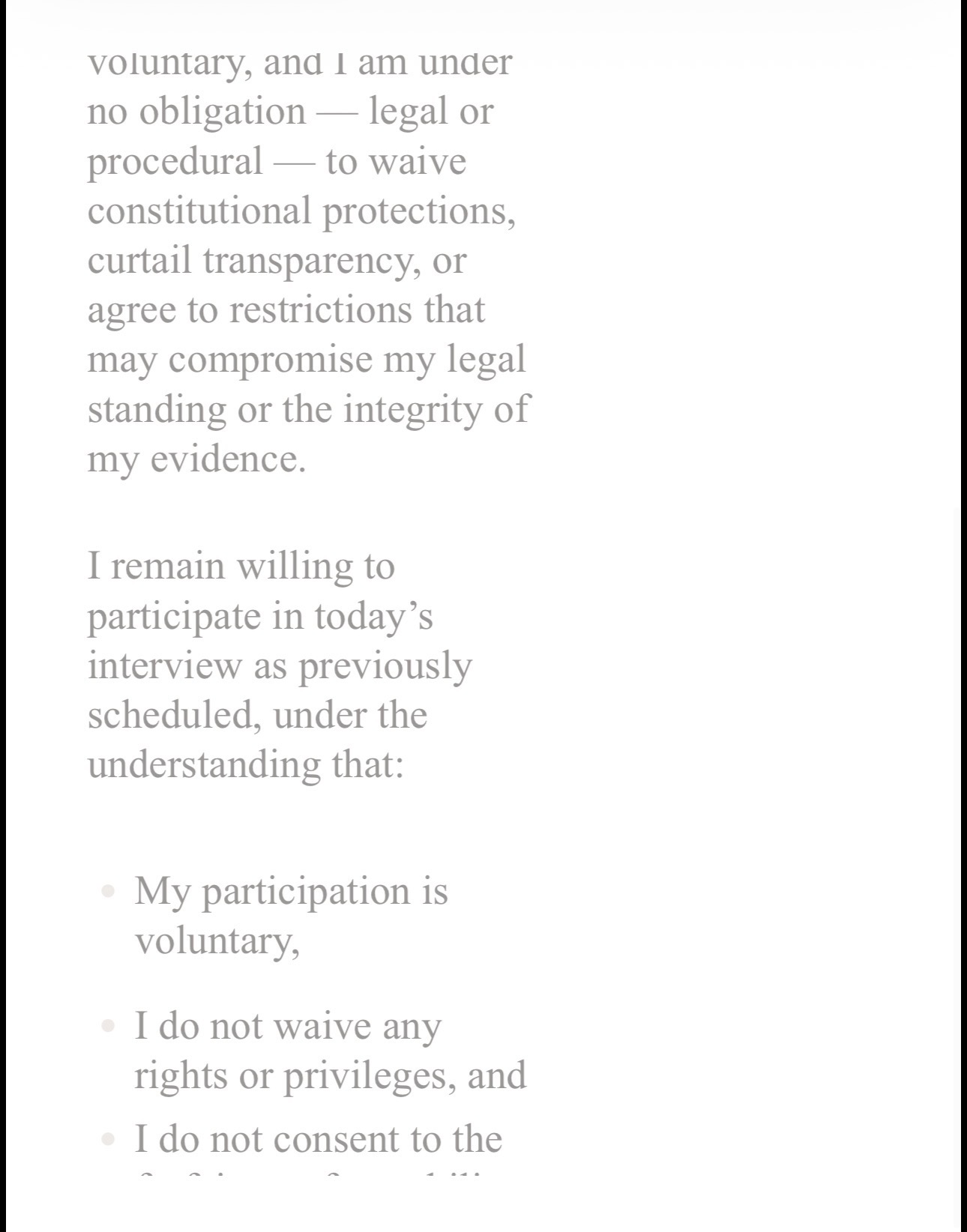
Exhibit P — My Written Response Objecting to the OIIG Agreements (Part 3)
Third section of my written objection stating that my participation was voluntary, that I would not waive rights or privileges, and that I would not consent to restrictions compromising my ability to protect myself without legal review.
Additional Related Records Available Upon Request
The following categories of records are not limited to a single image and may be produced in fuller form upon request:
Exhibit Q — Additional OPR Complaint Materials
Includes my written complaint explaining why the two write-ups were retaliatory, why one violated the labor ruling on cross-watching, and why the other was contradicted by camera evidence.
Exhibit R — Additional OPR Findings and Complaint-Register Records
Includes additional pages, findings language, and related materials tied to OPR’s review of my complaints against supervisory staff.
Exhibit S — Additional CPD / Employment Process Records
Includes additional materials reflecting how unresolved disciplinary allegations were used in the CPD process before my grievance victory.
Exhibit T — Additional OIIG Email Chain and Correspondence
Includes the broader email chain with Majed Assaf and OIIG concerning scheduling, documentation, objections, and the failure to meaningfully move the matter forward after I refused the last-minute terms.
Exhibit U — Additional Supporting Records and Public-Interest Documentation
Includes related materials, corroborating records, and supporting documentation previously referenced in the Unicorn Riot exposé and evidence vault.
Final Word
This article does not ask the reader to trust my feelings.
It asks the reader to look at the record.
Look at the assignment.
Look at the cross-watch dispute.
Look at the attempt to send me home.
Look at the reassignment to 3H.
Look at the accusation.
Look at the video-based contradiction.
Look at the grievance outcome.
Look at what OPR did with it.
Look at what happened when the unresolved discipline was sent to CPD.
Look at what happened when the evidence was taken outside the Sheriff’s Office.
Look at what other officers report.
Look at the pattern.
Then answer the question for yourself:
OPR: Office of Professional Review — Or Office of Institutional Power Preservation?
Are you a Cook County employee who has seen OPR ignore, soften, or reframe evidence to protect a supervisor or administrator? Contact the Cook County Corrections Coalition confidentially at cookcountycorrectionscoalition@gmail.com We are documenting the record the administration refuses to keep.
© 2026 Cook County Media Group LLC. All rights reserved.
Published by Cook County Media Group LLC.
Presented by the Cook County Corrections Coalition (C4).
Cook County Media Group LLC is an independent media company.
The Cook County Corrections Coalition (C4) is a nonprofit advocacy organization.
Editorial independence is maintained while amplifying public-interest reporting.










JOIN THE COALTION
You Wear the Badge. Now Join the Movement.
You deserve to be protected at work, to be compensated for your service, and respected for your actions. We will advocate for you. Whether you are a part of C4 or not, you deserve to have the protections we are fighting for, for yourself, for your family, and for your future. We must stand united. We will fight for you and the time to fight is now.
Join C4
Join the movement. Join the fight. Stand united.
We will provide you with a welcome email, informationals, invitations to meetings, and any advocacy support you may need.
Get Informed
Sign up to receive information, statistics, and updates.